Last Updated: November 11, 2026
Quick Summary
Residential pest control maintenance plans are scheduled, recurring treatment programs that keep a property protected year-round rather than reacting only when pests appear. A quality plan includes an initial full property assessment, internal and external treatment of cockroaches, ants, spiders and rodents, termite inspections at defined intervals, and a call-back provision if covered pests return within the warranty period.
- One-off treatments deal with what’s there, while maintenance plans deal with what’s coming.
- A legitimate plan should list its inclusions in writing before you sign.
- Older homes with subfloor access typically need two to three visits per year.
- Ask for the safety data sheet and the re-entry period before any treatment.
- Clear food scraps, fix leaking taps and trim vegetation back from exterior walls after treatment.
Table of Contents
- Why Residential Pest Control Maintenance Plans Beat One-Off Treatments
- Pest Control Plan Inclusions: What You Should Expect
- Building a Pest Control Maintenance Schedule That Fits Your Home
- Safe Pest Control for Pets and Children: What to Ask Before Treatment
- Questions to Ask a Pest Control Company Before Signing Up
- Post-Treatment Maintenance Tips and the Environmental Impact of Treatments
- Booking Your Residential Pest Control Maintenance Plan
- Frequently Asked Questions
Why Residential Pest Control Maintenance Plans Beat One-Off Treatments
Residential pest control maintenance plans are scheduled, recurring treatment programs that keep a property protected year-round rather than reacting only when pests appear. Residential pest control maintenance plans are built around the property, the household and the pests likely to be present.
One-off treatments deal with what’s there. Maintenance plans deal with what’s coming. For deeper evidence on the long-term advantages of proactive pest protection, that article lays them out. Termites, rodents and cockroaches don’t announce themselves, and a single visit leaves the gaps between treatments wide open. A scheduled plan can close those gaps with periodic inspection, baiting and monitoring.
Below, we explain what a good plan typically includes, how to judge whether it’s worth it, and the questions that separate a real program from a repeat call-out.
The DIY vs Professional Cost-Benefit Analysis
DIY pest control looks cheap at the hardware shop. Then you buy a second product because the first didn’t work, take a day off to re-treat, and still see ants trailing across the kitchen bench. Professional plans cost more per visit, but can reduce the number of failed attempts.
The real calculation isn’t product price versus service price. It’s how many treatments you’ll buy before the problem stops, plus the damage a missed termite inspection can do to a home’s structure. If you want to understand what drives professional pricing before deciding, our guide to what drives residential pest control cost breaks down the factors honestly.
DIY may suit a single wasp nest or a few ants in a rental you’re leaving. It rarely suits termites, rodents or recurring cockroaches.
Pest Control Plan Inclusions: What You Should Expect
A legitimate pest control plan should list its inclusions in writing before you sign. Most quality programs cover a defined set of pests, a set number of visits and a clear response if activity returns between them.
A plan’s inclusions should be clearly listed. Typical items to look for include:
- An initial full property assessment with pest identification, including roof void, subfloor and boundary checkpoints where accessible
- Internal and external treatment of the main pest groups: cockroaches, ants, spiders and rodents
- A termite inspection at defined intervals, with a written report that notes activity, damage and conducive conditions
- Seasonal baiting or monitoring stations where relevant, with stations numbered and mapped so the technician can check the same points each visit
- A call-back provision if covered pests return within the warranty period, with a stated response time
- Written records of every visit, including products used, active ingredients and application areas
A thorough plan typically structures visits around the property’s specific risks, with a clear record of what each visit covers. If a plan only describes ‘a spray’ without saying where and why, it is not a maintenance program.
What’s often missing is a named list of excluded pests. Wildlife such as possums is often handled under different rules and may be quoted separately. If a plan doesn’t say what’s excluded, assume it’s excluded.
Watch out: a plan that promises “all pests, all year” without specifying visit frequency or a call-back term is marketing, not a program. Ask for the schedule in writing, including what happens if you miss a scheduled visit.
Building a Pest Control Maintenance Schedule That Fits Your Home
A pest control maintenance schedule should match your property’s risk, not a generic calendar. Older weatherboard homes with subfloor access need more termite attention than a new concrete-slab townhouse. Homes with pets and young kids need different product choices.
Here’s how we’d structure a typical schedule:
| Home type | Visits per year | Priority services | Key timing |
|---|---|---|---|
| New slab home, no pets | 1-2 | General internal/external, rodent check | Spring |
| Older home with subfloor | 2-3 | Termite inspection, cockroach, rodent | Spring and autumn |
| Home with pets or toddlers | 2 | Pet-safe general treatment, ant management | Spring and autumn |
| Rural or acreage property | 3-4 | Rodent control, termite, spider removal | Seasonal |
Visits per year
Adjust the plan if you’ve had a previous infestation. A home that’s already had rodents needs more frequent monitoring than one that hasn’t.
Werribee-Specific Pest Seasonality
Werribee’s mix of river flats, new estates and older housing stock creates a pest calendar that differs from inner Melbourne. Ants push indoors as the weather warms and soil dries. Rodents move toward homes in the cooler months looking for warmth and food. Termite activity continues year-round in this climate, which is why an annual inspection matters more than a one-off check.
If you want to know which pests are common in Werribee and when they peak, that page maps the local patterns. Timing your maintenance visits to the season, not just to convenience, is the difference between a plan that works and one that ticks a box.
Safe Pest Control for Pets and Children: What to Ask Before Treatment
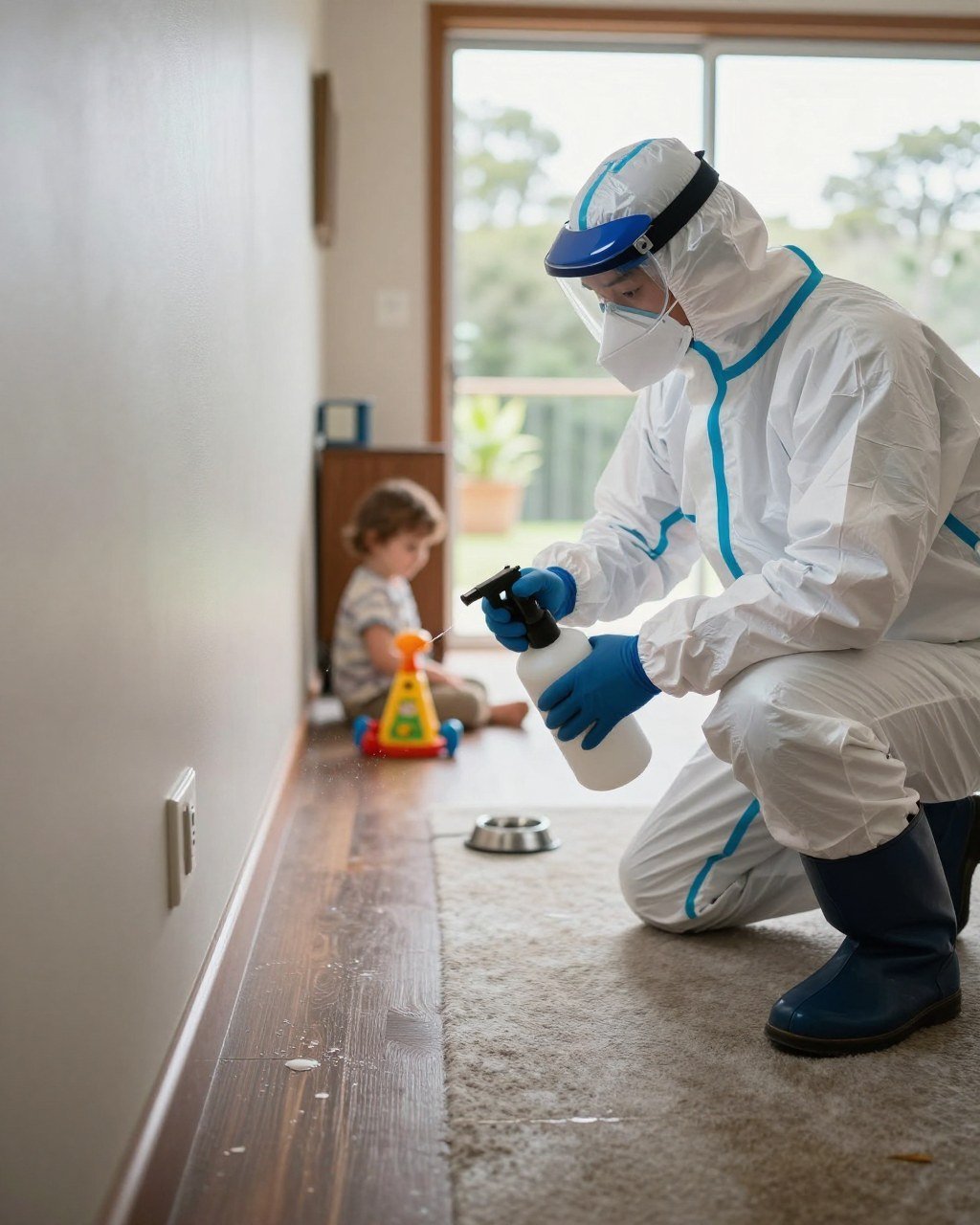
A “pet-safe” label means nothing unless the technician can explain the product, the application method and the re-entry time. Safe pest control for pets and children comes down to four things you should confirm before anyone sprays:
- Which active ingredients will be used, and are they registered for use in Australia?
- Where will the product be applied, and will it be wet or dry when you return?
- What’s the re-entry period for children and pets?
- What’s the call-back policy if a child or pet reacts?
Ask for the safety data sheet. A licensed technician will have it on hand and won’t dodge the question. If you want to explore lower-risk options first, our page on safe pest control alternatives for homes with pets covers diatomaceous earth, integrated pest management and vet-approved methods.
Watch out: “natural” doesn’t automatically mean safe. Some botanical products are still toxic to cats and fish. Get the specifics in writing.
Questions to Ask a Pest Control Company Before Signing Up
The questions to ask a pest control company matter more than the brochure. Ask them before you sign, and listen for specifics rather than reassurance. A good operator will answer each one plainly and put the key terms in the agreement.
- Are you licensed and insured, and can I see the certificate? Ask for the certificate number and the public liability cover amount, not just a verbal yes.
- What exactly is covered, and what’s excluded? Get the pest list and the exclusion list in writing.
- How many visits are included, and what triggers a free call-back? Confirm the response time and whether call-backs count against your visit allowance.
- What happens if the problem returns after the warranty period? Ask whether there is a re-treatment rate and what it covers.
- Can you provide a written report after every visit? A report should list products, active ingredients, areas treated and any new activity.
- Do you offer same-day or after-hours service for emergencies? Confirm whether this applies to plan customers and whether it carries a surcharge.
- What’s the fixed price, and are there any additional charges? Ask about travel, after-hours and call-back fees before you commit.
If a company can’t answer these plainly, that’s your answer. Vague reassurance about ‘being fully covered’ is not the same as a certificate and a written guarantee.
Licensing, Insurance and Guarantees
Pest control work is regulated, and a legitimate operator should be able to show current licensing and public liability insurance without hesitation. Ask for the certificate, not just a verbal yes. A written guarantee should state the covered pests, the warranty period and the remedy if treatment fails. If it’s vague, treat it as no guarantee at all.
Guarantees vary, and some cover re-treatment but not repair costs, so read the wording carefully. Ask whether the guarantee transfers if you sell the property, and whether it depends on you keeping up scheduled visits. Those conditions are normal, but they should be stated up front rather than discovered after a claim.
Post-Treatment Maintenance Tips and the Environmental Impact of Treatments
What you do after a treatment decides how long it lasts. Post-treatment maintenance tips that actually matter:
- Clear food scraps and seal bins so rodents and cockroaches have no reason to return
- Fix leaking taps and reduce moisture around foundations
- Trim vegetation back from exterior walls
- Store firewood away from the house
- Keep pet food sealed and off the floor overnight
- Note any new activity and report it before the next scheduled visit
On the environmental side, modern pest control leans on targeted application and integrated pest management rather than broad spraying. Ask your technician how they minimise non-target exposure, and whether baits or traps can replace sprays in sensitive areas. Responsible programs reduce product use over time because monitoring tells you when treatment isn’t needed.
Booking Your Residential Pest Control Maintenance Plan
Booking a plan should be straightforward. Tell us the property type, the pests you’ve seen, and whether you have pets or young children. A schedule can be recommended and confirmed in writing before the first visit is booked.
Trident Pest Control provides licensed and insured technicians across Werribee, Melbourne and Geelong. For current pricing, same-day availability and treatment options, request a free quote. You can view our residential pest control services and book a maintenance plan that fits your home.
Pests don’t wait for a convenient moment, and a plan built around your property beats a spray-and-hope approach every time. Trident Pest Control offers licensed and insured technicians, fixed pricing with no hidden charges, and kids and pet-safe treatments across Werribee, Melbourne and Geelong. Get started with Trident Pest Control and keep your home protected all year.
Frequently Asked Questions
What does a residential pest control maintenance plan usually include?
Most plans cover scheduled inspections and treatments for common pests such as ants, cockroaches, spiders and rodents, plus a pest identification report and advice on preventative measures. Some include termite inspections as an add-on rather than standard, so check before signing. A good plan also sets out the number of visits per year, what triggers a free re-treatment, and whether after-hours or emergency pest control is included. Ask for the inclusions in writing so there are no surprises later.
How often should a home have routine pest control in Werribee?
A quarterly pest control maintenance schedule suits most Werribee homes because it lines up with the warmer months when ants, cockroaches and spiders are most active. Homes near the Werribee River or backing onto grassland may need more frequent visits, while newer builds with fewer entry points can often manage with two visits a year. Your technician should adjust the frequency based on inspection findings rather than locking you into a fixed number regardless of results.
Are pest control maintenance plans suitable for homes with pets or children?
Yes, when the technician uses targeted, low-toxicity products and explains the re-entry time before starting. Ask what active ingredients will be used, where they will be applied, and how long pets and children should stay off treated surfaces. A reputable provider will give you this in writing and avoid broad spraying in areas where toddlers crawl or dogs sleep. Tell the technician about any allergies, pets or pregnant household members when booking.
What should I check before signing up for a pest control plan?
Confirm the licence and insurance of the business, the exact number of visits, which pests are covered and which cost extra, and what the guarantee actually promises. Ask whether the quote is fixed or an estimate, and whether callbacks for the same pest are included. Also check the cancellation terms and whether the plan transfers if you move house. Getting these answers upfront is the simplest way to avoid paying for visits that do not address your actual pest problem.
