Last Updated: November 5, 2026
Quick Summary
DIY pest control usually fails for severe infestations because it treats the visible insects rather than the hidden nest, colony or entry point inside walls, under floors or in roof voids. Surface sprays knock down foragers while the source keeps producing new pests, so results are temporary. Effective control starts with an inspection that locates the source before any product is applied.
- Surface sprays reach foragers but rarely reach nests hidden in wall cavities, subfloors or roof voids.
- Pests often stop appearing in the open because they have moved deeper, not because they are gone.
- Repeated sightings in daylight, droppings and mud tubes signal an established infestation needing professional help.
- Many DIY attempts fail because the product was not registered for the pest or was applied at the wrong dose.
- Professional treatment diagnoses the species and source first, then follows up to confirm the infestation has resolved.
Table of Contents
- Why DIY Pest Control Fails Against Hidden Nests and Colonies
- Treating Visible Pests Instead of the Source
- Pests Returning After Temporary Results
- Choosing the Wrong Product for the Pest
- Dangers of Improper Pesticide Use at Home
- Signs of Severe Pest Infestation That Need a Professional
- Professional Pest Control vs DIY: What a Technician Does Differently
- Pest Control Safety Regulations in Victoria and What They Mean for You
- Booking a Professional Inspection for Your Property
- Frequently Asked Questions
Why DIY Pest Control Fails Against Hidden Nests and Colonies
Most homeowners who try DIY pest control in Werribee start with a can of spray from the hardware store and a weekend of effort.
A bit of spray knocks down the foragers you can see, while the colony behind the skirting board keeps producing new workers.
A common mistake is assuming that fewer sightings means the problem is solved.
Treating Visible Pests Instead of the Source
Killing what you can see is satisfying, but it rarely addresses the cause. Ants, cockroaches, rodents and termites all organise their activity around a nest or harbourage point. Remove one worker and the colony simply sends another.
Effective control means finding where the pests live, how they enter, and what draws them in. Without that information, treatment is guesswork.
Pests Returning After Temporary Results
Temporary results are the most common outcome of DIY treatment. A product works for a few days or weeks, the numbers drop, and then the infestation rebuilds. Several factors cause this.
A home with recurring pests may have had several rounds of surface treatment without anyone locating the harbourage point. Treating the source and then removing the conditions that brought the pests in is the approach that addresses the cause.
Choosing the Wrong Product for the Pest
Pest control products are not interchangeable. A treatment designed for crawling insects may do little against rodents, and a product that works on ants may be unsuitable for termites.
The label is the first place to check. It states which pests the product is registered for, the correct application method and the safety precautions.
Product selection also depends on the setting. Baits suit some species, residual sprays suit others, and dusts are used in wall voids.
Dangers of Improper Pesticide Use at Home
Pesticides are designed to kill, and careless use creates real risks. Overuse can harm people and animals, contaminate food preparation surfaces and leave residues that persist for long periods. Underuse is also a problem: applying too little product can leave survivors that develop tolerance, making the infestation harder to control later.
Incorrect dosage, poor placement and inconsistent treatment
Dosage errors are common. Some people apply more product than the label allows, believing it will work faster. Others dilute it too heavily or spray only once when the label calls for repeat applications. Placement errors matter just as much. Baits placed where pests cannot find them do nothing, and traps set in the wrong runways catch nothing.
How DIY treatment can spread pests and affect kids and pets
Disturbing a nest without a plan can scatter colonies into new parts of the property. Wasps, ants and rodents may relocate into walls or neighbouring areas when their nest is sprayed carelessly. Households with children and pets face additional risk. Residues on floors, skirting boards and bedding can be picked up by toddlers and pets, and some products cause skin irritation, respiratory problems or poisoning if mishandled.
Signs of Severe Pest Infestation That Need a Professional
A single sighting is not the same as a severe infestation. The practical question is when the evidence stops looking like an occasional intruder and starts looking like an established population. Most practitioners find the following signs, especially in combination, mean DIY is no longer the right tool:
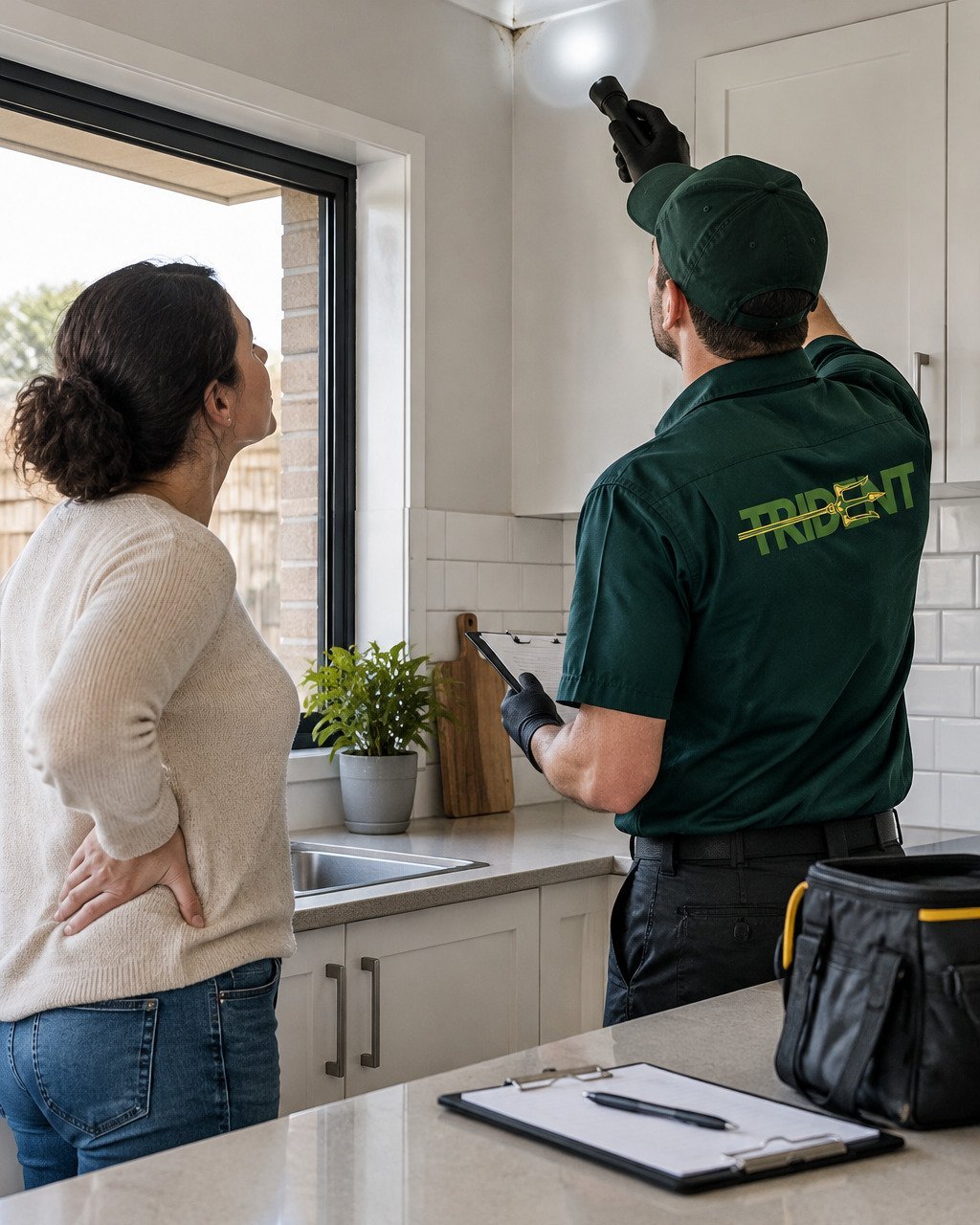
- Repeated sightings in daylight. Cockroaches and rodents that appear in the open during the day usually indicate a population large enough to have pushed foragers out of their harbourage.
- Activity in multiple rooms or on multiple floors. A problem confined to one kitchen cupboard is different from one spread across a bathroom, laundry and bedroom.
- Droppings, smear marks or gnaw damage. Rodent droppings along skirting boards, dark smear marks on wall edges and gnawed packaging point to regular traffic, not a one-off visitor.
How the warning signs differ by pest
Treating all infestations alike is one of the reasons DIY decisions go wrong. The escalation signs are pest-specific:
- Cockroaches. German cockroaches breed inside warm appliance housings and cupboard hinges. Seeing nymphs of mixed sizes during the day, or a persistent musty odour, suggests a harbourage that surface spraying will not reach.
- Rodents. Noises in walls and ceilings at night, combined with droppings in the pantry and gnaw marks on wiring, indicate a resident population rather than a transient one. Rodents also carry disease risk and can damage electrical cabling.
- Ants. Multiple trails converging on different entry points, or ants appearing in upstairs rooms, suggest satellite nests rather than a single colony. Spraying the trail often splits the colony and makes it worse.
Werribee seasonal patterns that raise the stakes
In Werribee and the surrounding Western Melbourne region, pest pressure can follow a seasonal rhythm. Warmer months bring increased ant and cockroach activity as colonies expand, while cooler months push rodents indoors seeking warmth and shelter.
If you have found mud tubes or a swarm, or you need urgent help, Trident Pest Control offers a book a termite inspection in Melton South with a written report and photos. For severe or urgent situations, a 24-hour emergency line for termite inspections provides immediate help alongside scheduled Monday to Saturday treatments.
Professional Pest Control vs DIY: What a Technician Does Differently
A professional treatment is not simply a stronger version of a hardware-store spray. The difference is the sequence: a technician diagnoses before treating, and the diagnosis determines everything that follows. Here is what that looks like in practice.
1. Inspection and identification
The technician inspects the property rather than the visible pest. That typically means checking roof voids, subfloor areas, wall cavities, meter boxes, appliance housings, moisture-prone zones and entry points around doors, windows and services. The species is identified before any product is chosen, because a treatment for cockroaches will not resolve a rodent problem and a general spray will not reach a termite colony.
2. Locating the source and the conditions
Inspection is not just about finding pests; it is about finding why they are there. The technician looks for harbourage points, entry gaps, moisture sources and food or waste attractants. This is the step DIY most often skips, and it is the reason surface treatments fail. Without locating the source, any product is applied to a symptom.
3. Selecting and applying the right treatment
Only after diagnosis does product selection happen. Baits suit some species and settings, residual sprays suit others, and dusts are used in wall voids and roof spaces. The technician applies the product at the label-specified dose and in the label-specified placement, and chooses formulations that suit the household, including where children and pets are present. Application methods are matched to the harbourage, not to the most visible pest.
4. Safety precautions and re-entry advice
Professional handling includes practical safety steps: containing the treatment area, ventilating where required, and advising residents on re-entry times and what to avoid afterwards. The technician explains what has been used, where, and why, so the household can make informed decisions about pets, children and food preparation areas.
5. Follow-up and confirmation
Severe infestations rarely resolve in a single visit. Follow-up visits confirm the treatment is working, check for re-activity, and adjust the approach if the pest has shifted harbourage. This monitoring step is what separates a resolved infestation from a temporary knockdown.
What this means for a DIY comparison
A DIY attempt usually covers step three only, and often with the wrong product for the pest. The inspection, source-location, safety and follow-up steps are where the outcome is actually decided. That is also why DIY results tend to be temporary: the visible pest is treated, but the conditions that produced it are left in place.
The table below sets out the five steps a technician follows, in the order the article describes them, so the difference from a typical DIY attempt is easy to scan.
| Step | What the technician does | Why it matters |
|---|---|---|
| Inspection and identification | Checks roof voids, subfloors, wall cavities, meter boxes and entry points | Pests are identified before any product is chosen |
| Locating the source | Finds harbourage points, entry gaps, moisture and food attractants | Treats the cause, not just the symptom |
| Selecting and applying treatment | Matches baits, sprays or dusts to the pest and label dose | The right product is used in the right place |
| Safety and re-entry advice | Contains the area and explains re-entry times and precautions | Household, children and pets are protected |
| Follow-up and confirmation | Checks for re-activity and adjusts the approach | Separates a resolved infestation from a temporary knockdown |
Pest Control Safety Regulations in Victoria and What They Mean for You
In Victoria, pesticide use is regulated under the Agricultural and Veterinary Chemicals (Victoria) legislation and administered through the Victorian Department of Energy, Environment and Climate Action (DEECA). Pest control businesses must hold appropriate licensing, and the products they use must be registered for their intended purpose. Victorian Government guidance on pesticide use and licensing
For homeowners, the practical meaning is straightforward. Products should be used according to the label, stored safely away from children and animals, and disposed of correctly.
Booking a Professional Inspection for Your Property
If you have tried DIY treatment without lasting results, a professional inspection is the most efficient next step. It identifies the species, locates the source and gives you a clear treatment plan. When choosing a provider, check that technicians are licensed, that the company explains its findings before treating, and that follow-up visits are included where needed.
Visit our website for more details about our services and to request a quote.
Frequently Asked Questions
Why do store-bought pest sprays fail to stop severe infestations?
Most store-bought sprays kill only the insects they touch at the moment of spraying. Pests that nest inside wall voids, under floors or in roof spaces are rarely reached, so the colony keeps breeding. Many products also carry label directions that limit where and how often they can be used, and a surface spray does not reach the source. For a heavy or recurring problem, a licensed technician can identify the nesting site, choose a product registered for that pest, and apply it under the label conditions required in Victoria.
What are the health risks of using DIY pest control chemicals incorrectly?
Incorrect use of pesticides can cause skin irritation, respiratory problems and poisoning, with children and pets most at risk because they spend time close to the floor and put things in their mouths. Overuse, mixing products or spraying in enclosed spaces raises the risk. Always read the label, keep children and pets out of treated areas for the stated period, and store products out of reach. If someone is unwell after exposure, contact the Poisons Information Centre on 13 11 26 or call 000 in an emergency.
When should I stop trying DIY methods and call a professional in Werribee?
Call a professional if the pest keeps returning after treatment, if you cannot find where the pests are coming from, or if you see activity in several rooms at once. Other warning signs include droppings or damage in wall cavities, pests appearing during the day, and a problem that spreads despite repeated treatment. A licensed technician can inspect the property, identify the species and give a clear plan for treatment and follow-up. Pricing depends on the size of the property and the pest involved, so check Trident Pest Control’s website for current prices or request a quote.
Are professional pest control services in Victoria regulated?
Yes. Pest control work involving pesticides is regulated, so check the current official requirements. Ask any provider to confirm their licence and public liability cover before the job starts, and check that the products they use are registered for the pest being treated. Working with a licensed operator gives you a clear point of accountability if something goes wrong during treatment.
