
Last Updated: November 6, 2026
Quick Summary
The common entry points for ants in Melbourne apartment blocks are door thresholds, window frames, balcony joints, cracks and skirting boards, and service penetrations around pipes and cables. The gap under your front door is the single most common entry point in any apartment. Most residents never check service penetrations, which are rarely sealed properly.
- Check for daylight under doors and worn seals, since gaps widen with building movement.
- Fine soil or debris on a window sill signals nest building behind the frame.
- Treat the nest before sealing, or ants will find another way out.
- Service risers let a ground-floor colony follow pipework into units several levels above.
- Photograph trails heading into shared walls and report them to your building manager.
Table of Contents
- Where Ants Get In: Mapping the Common Entry Points
- Doors, Thresholds and Gaps Beneath Doors
- Window Frames, Screens and Balcony Joints
- Cracks, Skirting Boards and Floor Edges
- Service Penetrations: Pipes, Cables and Wires
- How to Stop Ants Entering an Apartment: A Room-by-Room Checklist
- Ants Coming Through Apartment Walls: Shared Routes Between Units
- Ant Trails in Kitchen and Bathroom: Following the Trail to the Nest
- Frequently Asked Questions
Where Ants Get In: Mapping the Common Entry Points
Most residents spray the ants they can see, then wonder why they’re back in a fortnight.
You can’t treat an entry point you haven’t found. Below, we show you where to look, room by room, and how to tell an entry point from a nest.
These are the entry points the article identifies as the recurring routes ants use in Melbourne apartment blocks.
| Entry point | Where to check | Key detail |
|---|---|---|
| Door thresholds and gaps beneath doors | Base of each door, seals, loose thresholds | Single most common entry point in any apartment |
| Window frames and screens | Sills, screen tears, sealant around frames | Fine soil or debris on the sill signals nest building |
| Balcony joints | Where balcony meets wall, slab edges | Dried, cracked sealant opens a path into the wall cavity |
| Cracks, skirting boards and floor edges | Skirting joins, floor-to-wall gaps, grout, cornices | Easy to miss because gaps look too small |
| Service penetrations | Under sinks, behind toilet, hot water system, cabling entries | Most residents never check these; rarely sealed properly |
Doors, Thresholds and Gaps Beneath Doors
The gap under your front door is the single most common entry point in any apartment.
Check for daylight under the door when closed, worn or flattened seals, loose thresholds with gaps at the edges, and cracks where the frame meets the wall.
Run a torch along the base of each door at night, ants forage after dark, so a line crossing the threshold is easy to spot.
Window Frames, Screens and Balcony Joints
Window frames and balcony joints are the second big route, especially in apartments with planter boxes or potted plants on the balcony.
Look for fine soil or debris on the sill, a sign of nest building behind the frame.
Balcony joints deserve special attention in older blocks, where sealant dries and cracks, opening a path into the wall cavity. Exterior-grade sealant fixes most of these, but treat the nest first.
CSIRO research on household ant species
Cracks, Skirting Boards and Floor Edges
Cracks in walls, skirting boards and floor edges are the quiet entry points.
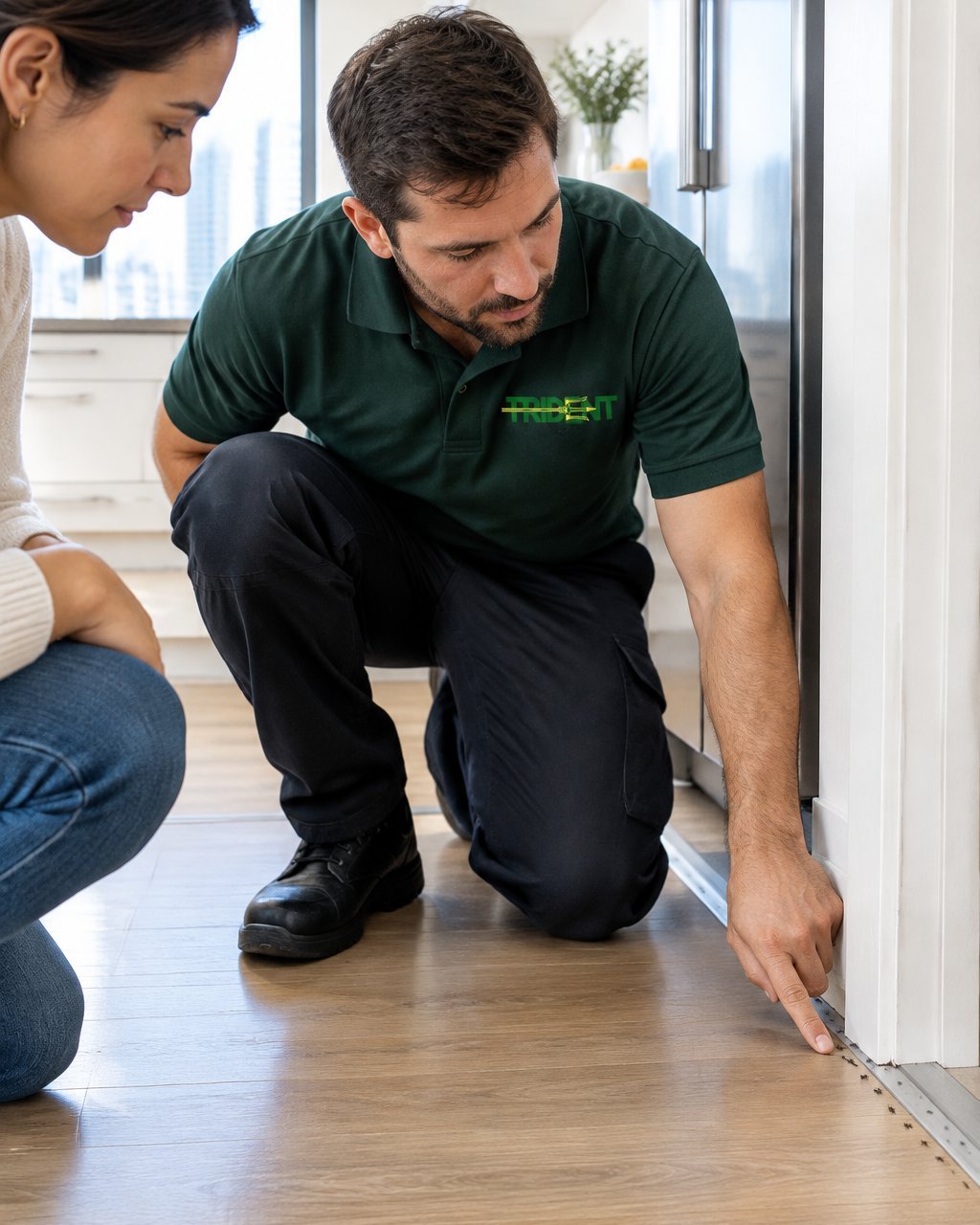
Check skirting board joins at corners, gaps where the floor meets the wall, cracks in tiled splashbacks and grout, and loose cornices and ceiling edges.
A common mistake is filling a crack and calling it done.
If ants are pouring through a crack right now, an emergency ant control service can stop the activity before it spreads to neighbouring units.
Service Penetrations: Pipes, Cables and Wires
Service penetrations are gaps around pipes, cables and wires entering your unit, and they’re the entry points most residents never check.
Look under sinks, behind the toilet, near the hot water system and where cabling enters a wall.
Seal unused penetrations with an appropriate filler, and check that existing seals haven’t shrunk or cracked. For active infestations, a licensed pest controller should treat the cavity first.
How to Stop Ants Entering an Apartment: A Room-by-Room Checklist
To stop ants entering an apartment, work through each area in order: find the entry points, treat the nest, then seal. Once the nest is treated, sealing pest entry points around shared walls, service penetrations and unit thresholds helps keep ants from retracing the same route.
Before you start, get a torch, a small mirror or your phone camera for tight gaps, and something to photograph what you find. Photographs matter later if you need to involve a landlord or owners corporation.
Inside the unit
Kitchen
- Check behind the dishwasher, under the sink and around the kickboards
- Inspect the gap where the benchtop meets the wall and where splashback tiles meet the bench
- Look along skirting boards for trails and fine debris
Bathroom and laundry
- Check pipe penetrations under the vanity, behind the toilet and behind the washing machine
- Inspect floor drains and tile grout for gaps
- Fix any leaking taps or shower roses, since moisture draws ants
Living areas and bedrooms
- Check window frames, sills and the sealant around them
- Inspect skirting board joins at corners and where the floor meets the wall
- Look behind furniture pushed against exterior or shared walls
Hallway and entry
- Check the front door threshold and seal
- Inspect the door frame where it meets the wall
- Look at the meter box, intercom and any wall-mounted fixtures in the entry area
Balcony and exterior of the unit
- Check door thresholds and seals to the balcony
- Inspect balcony joints, slab edges and the sealant where the balcony meets the wall
- Check planter boxes, pots and any stored items for nests
Common areas (report, do not treat)
- Note ant trails in corridors, stairwells, bin rooms and car parks
- Check the base of shared walls and riser doors
- Photograph and report anything on common property to the building manager or owners corporation
Entry point or nest? How to tell the difference
This is the step most checklists leave out, and it changes what you do next.
- An entry point is where ants cross from outside or a shared route into your unit: a single line, ants moving in both directions, no debris at the gap.
- A nest is where the colony lives: a soil mound, frass, crumbs pushed out of a gap, or a dense cluster of ants and eggs, with the trail ending there.
- A satellite nest is common in apartment blocks, a small nest in a wall cavity or behind a skirting board, separate from the main colony. Treating the satellite alone will not stop the infestation.
If the trail disappears into a wall, a riser or a shared wall and you cannot see a nest, treat it as a shared-route problem and involve your landlord or building manager rather than sealing it yourself.
What you can safely seal, and what to leave alone
Residents can generally seal small, dry gaps inside their own unit: skirting board joins, cracks in plaster, gaps around window frames, and the gap under an internal door.
Leave these to a licensed professional or the building manager:
- Gaps around gas, electrical or plumbing penetrations
- Anything in a riser, common wall or common area
- Gaps that provide ventilation to a cavity, appliance or drain
Watch out: blocking a weep hole or ventilation gap to stop ants can trap moisture in the wall and cause worse damage than the ants.
If the checklist turns up more than one active route, or a trail leading into a shared wall, read our guide to getting rid of ants in Melbourne before you start sealing.
Ants Coming Through Apartment Walls: Shared Routes Between Units
Ants coming through apartment walls almost always means one colony is using shared structure to move between units.
Here are the shared routes that matter most in Melbourne apartment blocks:
- Service risers and vertical shafts. Plumbing, electrical and communications risers run floor to floor and are rarely sealed at each penetration. A colony in a ground-floor planter or basement can follow pipework upward and emerge in units several levels above.
- Plumbing and drainage penetrations. Every sink, toilet, shower and laundry waste pipe passes through a slab or wall. The gap around the pipe is often wider than the pipe itself, and ants use the annular space as a permanent corridor.
- Shared wall cavities. In brick-veneer and double-brick walk-ups, the cavity between units is a continuous void. Ants enter at one weak point, a cracked mortar joint, an unsealed meter box, a balcony fixing, and travel laterally along the cavity.
This is why DIY treatment stalls. You treat your kitchen, the ants retreat along the shared route to the unit next door or back to the riser, and they return once the spray fades.
Watch out: sealing every gap inside your own unit without addressing the shared route can push ants into a neighbour’s unit and make the problem harder to trace.
Who is responsible in a strata building?
In Victoria, owners corporations are generally responsible for common property (What is an owners corporation?). Check the current legislation and your owners corporation rules with the relevant state authority before relying on this.
A practical sequence for residents:
- Document the trail. Photograph where ants enter your unit and where the trail heads, into a wall, a riser, a common corridor or a balcony joint.
- Notify your landlord or property manager in writing, with the photos. Check the current Victorian rental rules with the relevant state authority to confirm who is responsible for pest issues.
- Notify the owners corporation or building manager if the trail leads into common property, a riser or a shared wall, and ask whether the building has a pest management plan or inspection schedule.
- Coordinate treatment. A licensed pest controller should inspect the shared route and adjoining units, not just yours, treating one unit in isolation is the most common reason infestations recur.
A strata and body corporate pest control program covers common areas, unit treatments and the reporting owners corporations usually ask for.
Werribee’s newer apartment developments and older walk-ups both show this pattern, for different reasons.
Ant Trails in Kitchen and Bathroom: Following the Trail to the Nest
Ant trails in the kitchen and bathroom are your best clue to the nest.
Follow the trail slowly, and don’t disturb it. Watch where it disappears into a wall, skirting board or frame. That’s the entry point, and often the nest entrance is close by.
Signs you’re near a nest:
- A fine soil mound or debris pile
- Frass or crumbs pushed out of a gap
- A steady line of worker ants moving in one direction
Ignoring a trail is a mistake. Our guide on why you shouldn’t ignore ant trails in your kitchen explains the contamination and damage risk.
Once you’ve found the nest, don’t spray it directly.
Ants in an apartment block are a building problem, not just a kitchen problem. Trident Pest Control offers licensed and insured technicians, kid and pet-safe treatments, and fixed pricing with no hidden charges. Get your free quote to stop the colony at its source.
Frequently Asked Questions
Where do ants usually enter an apartment?
Ants most often enter through gaps beneath doors and along thresholds, around window frames and balcony joints, cracks in walls and skirting boards, and service penetrations where pipes and cables pass through. In apartment blocks, shared wall cavities and riser shafts can carry them between units. Check these ant entry points first, then follow any visible trail back to its source before sealing.
How do ants get into apartments on higher floors?
Ants reach upper floors by travelling along service pipes, cables and wall cavities, or by moving across balconies and exterior cladding. They can also hitch a ride on potted plants, furniture or deliveries. Once inside, they follow established ant trails between units. Sealing gaps around penetrations and keeping balconies clear of food and moisture reduces the routes available to them.
Why do ants keep coming back to my Melbourne apartment?
Recurring activity usually means the nest was not treated, only the visible trail. Ants also return when food, moisture or shelter remains available. In apartment blocks, treating one unit while the shared nest survives in a wall cavity or common area leads to reinfestation. A licensed pest controller can locate the nest and treat the source, then advise on sealing gaps to prevent access.
When should an apartment block contact a pest control professional?
Call a professional when ants persist after DIY sealing and cleaning, when trails appear in multiple units, or when you suspect a nest inside a wall cavity or common area. Strata buildings should coordinate treatment through the owners corporation so the source is addressed, not just one apartment. A licensed pest controller can inspect, identify the species and recommend targeted, kid and pet-safe treatment.
