
Table of Contents
- What Ant Trails Really Mean
- Understanding Pheromone Trails and Scout Ants
- Health and Contamination Risks from Ant Infestations
- How to Identify Ant Entry Points Before They Spread
- Natural Ant Repellent for Kitchen Prevention
- Spotting Signs of Ant Infestation in Walls and Hidden Areas
- When DIY Methods Fail: Why Professional Pest Management Matters
- Frequently Asked Questions
What Ant Trails Really Mean
Ant trails in your kitchen are a warning sign that a colony has already established a supply route from their nest to a food source. What you’re seeing is the visible tip of an organised foraging operation built by scout ants using chemical highways. Most people make a critical mistake: they see a few ants, wipe them away, and assume the problem is solved. In reality, those visible ants represent only a fraction of the colony‘s workforce. Thousands of worker ants back at the nest are ready to follow that same trail and exploit whatever food source attracted the scouts.
The pheromone trail persists long after you’ve wiped away the visible ants. This chemical signal remains active for hours, sometimes days, guiding reinforcements back to the same spot. Each new wave of foragers strengthens the trail, making it more attractive to other workers. Within days, what started as a handful of scouts can become hundreds of ants streaming through your kitchen daily. Ignoring ant trails in kitchen spaces is one of the most common mistakes homeowners make, and it’s the reason infestations spiral out of control so quickly.
Ignoring an ant trail means the colony has already found a reliable food source inside your home. Without intervention, the infestation will grow exponentially as more workers are recruited to exploit that resource.
Understanding Pheromone Trails and Scout Ants
Pheromone trails are chemical signals that ants use to communicate with each other, creating an invisible map that guides thousands of workers to food sources. When a scout ant discovers something edible, a crumb, a spill, or residue from takeaway packaging, it deposits a trail of pheromones as it walks, laying down chemical breadcrumbs that other ants can follow.
This system is extraordinarily efficient. A single scout’s discovery can mobilise an entire workforce within hours. According to research from the University of Sydney entomology department, coastal brown ants forage three times further and recruit twice as many workers when relative humidity exceeds 70%. In humid conditions common in Australian kitchens during summer, the colony’s response to your kitchen’s food sources becomes dramatically more aggressive.
Scout ants are the architects of this problem. These smaller, faster workers venture out from the nest exploring new territory in search of resources. Once a scout finds food, it returns to the nest and communicates the discovery through pheromone signals. Other ants follow that chemical trail, and the more ants that traverse it, the stronger and more attractive the trail becomes to additional workers.
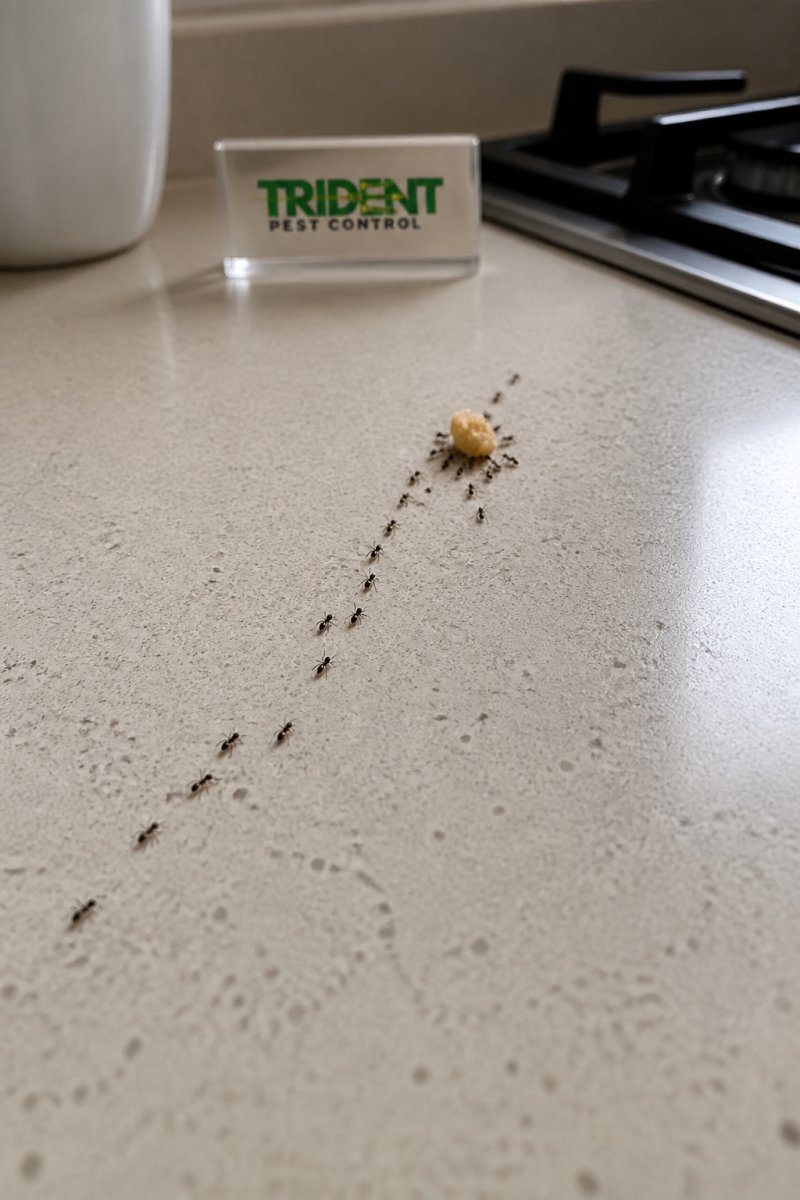
The reinforcement cycle is relentless. According to [NSW Department of Primary Industries pest control(/pet-safe-pest-control-methods/) guidance | dpi.nsw.gov.au], boiling water kills only 11-14% of a typical coastal brown ant colony, with foraging workers often returning to rebuild the nest in a new location. This illustrates a critical point: surface-level interventions don’t address the colony’s core structure or its ability to re-establish trails.
Temperature also plays a role in how aggressively ants exploit a food source. For every 1°C rise in average monthly temperature, ant foraging activity increases by roughly 15% across NSW coastal suburbs. During warm months, the colony’s entire workforce becomes more active, meaning the pheromone trail strengthens faster and more ants respond to it simultaneously.
Scout ants are the first problem; the pheromone trail is the second. Ignoring the trail means ignoring a chemical signal that’s actively recruiting hundreds of additional workers to your kitchen.
Health and Contamination Risks from Ant Infestations
Most people think of ant infestations as a hygiene issue, not a health threat. A 2018 study on ants as vectors of foodborne pathogens found that 72% of respondents agreed ants constitute a hygienic issue but did not perceive them as a serious threat to human health. That perception is dangerously inaccurate. The same study’s microbiological analysis revealed that ants systematically harbour yeasts and moulds (100% of samples tested), coliforms frequently (52%), and transfer E. coli to food surfaces at a rate of 70%.
Ants are mechanical vectors for disease-causing pathogens. They crawl through soil, decomposing organic matter, drains, and other contaminated areas before entering your home. Every surface they traverse, your kitchen bench, your food containers, your family’s plates, becomes a potential infection route. Ants can carry Salmonella, E. coli, Staphylococcus aureus, Clostridium, Streptococcus, and Shigella, all capable of causing foodborne illness.
The risk escalates for vulnerable populations. While most healthy adults can fight off exposure to these pathogens, immunocompromised individuals, young children, and elderly people face significantly higher risks. If you have a toddler or an elderly family member at home, an ant infestation is a genuine health hazard.
According to [Vinx Pest Control(/category/pest-control/)’s kitchen contamination research | vinxpestcontrol.com.au], 60% of Sydney home ant infestations are linked to leftover takeaway grease, which creates an ideal attractant and breeding ground for bacterial colonies. When ants feed on this grease and then traverse your clean food preparation areas, they’re transferring both the grease and any pathogens it harbours.
Ants transfer E. coli to food surfaces at a 70% rate. Ignoring an ant trail means accepting active pathogenic contamination in the space where you prepare meals for your family.
How to Identify Ant Entry Points Before They Spread
Finding where ants enter your home is the critical first step in stopping an infestation before it establishes itself throughout your property. Ants follow a specific route from their nest (usually outside) into your home. Identifying and sealing these entry points can prevent new colonies from establishing themselves, though it won’t eliminate an existing infestation.
Start by following the ant trail backwards. Watch where the ants are heading and trace their path to the source. Most kitchen ant trails lead to a gap, crack, or crevice that connects your home’s interior to the outside. Common entry points include gaps around window frames, cracks in mortar between bricks, spaces where pipes enter the building, gaps under doors, and openings around electrical outlets or ventilation ducts.
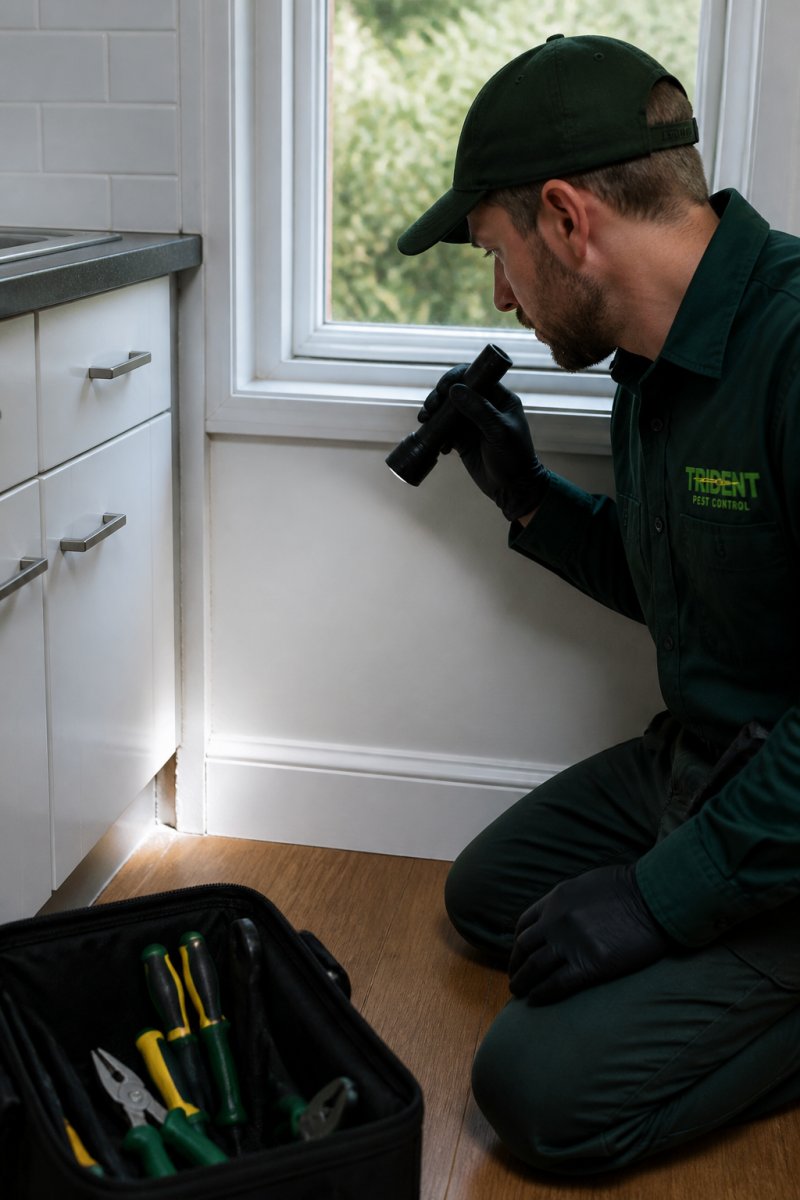
Ants can squeeze through openings as small as 1 millimetre. Gaps you might consider insignificant are actually highways for ant traffic. Use a torch and inspect your kitchen’s perimeter carefully, paying special attention to areas where different materials meet, as these transitions often create small gaps that ants exploit.
Look for these high-risk zones:
- The junction where your kitchen bench meets the wall
- Gaps between floorboards and the base of the wall
- Spaces around water pipes under the sink
- Cracks in the grout between tiles
- Gaps around window and door frames
- Holes where electrical cables enter the wall
Once you’ve identified potential entry points, you can begin sealing them. However, this approach only works for prevention. If you already have an active infestation, sealing entry points without eliminating the nest simply traps ants inside your home, forcing them to find alternative routes and potentially establish secondary nests in walls or other hidden areas.
Natural Ant Repellent for Kitchen Prevention
Natural deterrents can help reduce ant activity in your kitchen, though they’re most effective as part of a comprehensive prevention strategy rather than a standalone solution. These methods work by disrupting pheromone trails, creating barriers that ants avoid, or removing the attractants that draw them in the first place.
Vinegar is one of the most effective natural repellents. Mix equal parts white vinegar and water in a spray bottle and apply it to areas where you’ve seen ant activity. The vinegar’s strong smell masks pheromone signals, making the trail invisible to other workers. Spray along the ant trail, around entry points, and along kitchen baseboards.
Citrus oils offer another natural option. According to Department of Entomology and Plant Pathology research, orange oil emulsified with water was the most effective way to utilise the oil to kill ants. The citrus compounds break down the ants’ exoskeleton and disrupt their ability to navigate using pheromones. You can create a citrus spray by mixing a few drops of lemon or orange essential oil with water.
Cinnamon and coffee grounds are natural deterrents that ants actively avoid. Sprinkle cinnamon powder along entry points and around areas where you’ve spotted ant activity. Similarly, place coffee grounds around the kitchen perimeter; ants find the smell unpleasant and tend to avoid these areas.
However, it’s critical to understand the limitations of these natural methods. They disrupt trails and deter ants, but they don’t eliminate the colony. An established nest will continue to produce new scouts and new pheromone trails. Natural repellents are best used as preventative measures in homes that don’t yet have an infestation, or as supplementary measures alongside professional pest management.
Combine natural repellents with rigorous kitchen hygiene. Remove food sources first, then apply deterrents to reinforce the message that your kitchen isn’t worth the effort.
Spotting Signs of Ant Infestation in Walls and Hidden Areas
Ants don’t always march across your kitchen bench in visible trails. Many infestations hide inside walls, under floorboards, and in other concealed spaces where you won’t notice them until the problem becomes severe. Learning to spot these hidden signs is essential for catching an infestation before it spreads throughout your home.
Listen for rustling sounds inside walls, particularly at night when the colony is most active. Thousands of ants moving through wall cavities create a faint but audible noise if you press your ear against the wall. This sound is often one of the first indicators that a colony has established itself inside your home’s structure.
Look for small piles of sawdust or debris near baseboards, in corners, or along wall cavities. Some ant species excavate tunnels through wood and other materials, creating these telltale piles as they clear their pathways. Check for staining or discolouration on walls and ceilings. Large ant colonies produce formic acid as a waste product, and this acid can leave faint brown or yellow stains on surfaces.
Inspect wooden structures for damage. Carpenter ants and some other species excavate galleries through wood to create nesting spaces. If you notice small holes in wooden beams, floorboards, or structural elements coupled with the presence of ants, you may have a significant structural infestation requiring professional assessment.
In 2026, Argentine ants made up 54% of indoor ant infestations in Sydney, according to NSW Department of Primary Industries urban pest surveys. These ants are particularly problematic because they form massive supercolonies with multiple queens, making them extremely difficult to eliminate without professional intervention.
When DIY Methods Fail: Why Professional Pest Management Matters
DIY ant control rarely works, and when it does, it’s usually temporary. Surface-level treatments don’t address the colony’s core structure or the pheromone communication system that keeps it organised and growing. Most homeowners spend weeks applying natural repellents, spraying visible ants, and cleaning aggressively, only to watch the infestation return within days or weeks.
Spraying visible ants with pesticide doesn’t work because it only kills a tiny fraction of the colony. In fact, spraying repellent products at certain species can cause the colony to split and establish new nests elsewhere on the property, making the problem harder to solve. This phenomenon, called “budding,” turns one infestation into multiple infestations scattered throughout your home.
Professional pest management works differently. Trident Pest Control’s approach combines identification, strategic baiting, residual chemical application, and follow-up monitoring to eliminate the colony at its source. Our licensed and insured technicians assess the specific ant species, locate the nest, and deploy treatments that target the colony’s reproductive core, the queen and her workers.
The difference is expertise and accountability. When you call Trident Pest Control, you’re getting a comprehensive assessment, a targeted elimination strategy, and follow-up visits to ensure the infestation doesn’t return. Our team understands ant behaviour, species-specific preferences, and the conditions that allow infestations to flourish. Professional treatments use baiting systems that workers carry back to the nest, poisoning the queen and the colony’s core. This approach is far more effective than surface sprays because it targets the source of the infestation. Trident Pest Control provides kids and pet-safe treatments, so you don’t have to choose between eliminating the infestation and protecting your family.
Many homeowners delay calling a professional because they’re concerned about cost or disruption. However, the longer an infestation persists, the more entrenched it becomes. Professional pest management, when done early, is far more cost-effective than months of failed DIY attempts followed by emergency intervention.
DIY methods fail because they don’t address the colony’s structure or the pheromone communication system. Professional pest management eliminates the colony at its source, preventing the re-entry cycle that makes infestations persistent.
Ignoring ant trails in your kitchen means accepting an active infestation that’s growing exponentially every day. The visible trail is just the beginning; behind it are thousands of workers, a functioning colony, and a pheromone communication system designed to recruit more ants to the food source you’ve inadvertently provided. Trident Pest Control specialises in identifying ant species, locating nests, and deploying targeted treatments that eliminate colonies at their source. Our licensed technicians provide kids and pet-safe solutions with fixed, transparent pricing and same-day service availability. Get your free quote today and stop the infestation before it spreads throughout your home.
Frequently Asked Questions
Q: What does an ant trail in the kitchen really indicate?
A: An ant trail shows that scout ants have found a food source and laid down pheromone signals to recruit more workers. A visible trail of just a few ants typically means a larger colony is nearby. Once the pheromone trail is established, worker ants will continue following it in increasing numbers until you address both the trail and the colony. Ignoring it allows the infestation to grow exponentially within days.
Q: Can ants in my kitchen contaminate food and surfaces?
A: Yes. Research confirms ants transfer E. coli to food surfaces at a rate of 70%, and they carry pathogens including Salmonella, Staphylococcus aureus, and Shigella. Ants crawl through drains, bins, and decaying matter before entering your kitchen, picking up bacteria on their bodies. Vulnerable populations, young children, elderly people, and immunocompromised individuals, face particular risk from foodborne illness caused by ant contamination.
Q: Why do simple cleaning or spraying visible ants not work?
A: Spraying individual ants kills only a tiny fraction of the colony and does not disrupt the pheromone trail that guides more workers. In fact, spraying repellent products can cause the colony to split and establish new nests elsewhere on your property, making the problem harder to solve. The root cause, the nest itself, remains untouched, so the infestation persists or spreads.
Q: How quickly can an ant infestation grow if I ignore the trail?
A: Ant numbers increase rapidly once a pheromone trail is established. Temperature and humidity accelerate recruitment: for every 1°C rise in temperature, foraging activity increases by roughly 15%. At humidity levels above 70%, coastal brown ants recruit twice as many workers and forage three times further. In warm, wet months, ant-related pest callouts in Sydney double compared to cool, dry periods, demonstrating how fast conditions can escalate.
This article was written using GrandRanker