Table of Contents
- Why Rodent Pest Management Beats DIY Traps and Baits
- Signs of Rats and Mice in the Home
- How Pest Professionals Inspect for Rodents
- Safe Rodent Control Around Pets and Children
- Faster Results and Fewer Repeat Infestations
- Preventing Rodents After Pest Treatment
- The Bottom Line on Rodent Pest Management
- Frequently Asked Questions
Last Updated: October 13, 2026
Why Rodent Pest Management Beats DIY Traps and Baits
The benefits of professional pest management for rodents start with one uncomfortable fact: store-bought traps and baits rarely solve an infestation, because they treat the symptom, not the cause. At Trident Pest Control, we see the same pattern across Werribee and Melbourne’s west. A homeowner sets a few snap traps, catches two mice, and assumes the problem is over. Three weeks later, the scratching returns.
Rodents are cautious, social animals. They learn from trapped companions and often avoid the very devices that caught them. A single breeding pair can produce dozens of offspring in a season, so removing two or three animals barely dents the population.
- DIY baits leave dead rodents in wall cavities, where they decompose and smell
- Traps catch only the boldest animals, not the colony
- Nobody checks entry points, so new rodents keep walking in
Professional rodent management works differently. It combines inspection, exclusion, and targeted treatment into one plan. That’s the core difference, and it’s why repeat callouts are so common after DIY attempts.
Traps and baits remove individual rodents. Professional rodent management removes the conditions that let them return.
Signs of Rats and Mice in the Home
Droppings are the most reliable sign of rats and mice in the home, followed by greasy rub marks along skirting boards and a musky, ammonia-like smell in enclosed spaces.
Mice leave small, dark pellets about the size of a grain of rice. Rat droppings are larger and thicker, closer to a raisin. Fresh droppings feel soft and shiny; older ones are dry and dull. Where you find them matters too. Droppings along wall edges, behind appliances, and inside roof voids point to regular travel routes.
Other signs worth checking:
- Gnaw marks on food packaging, cables, or timber
- Shredded paper, insulation, or fabric in a nest corner
- Scratching or scurrying sounds after dark
- Pets staring at walls or skirting boards
- Unexplained damage to stored dry goods
If you spot two or more of these together, you’re likely looking at an established population rather than a single stray animal. That distinction changes how the problem should be treated.
How Pest Professionals Inspect for Rodents
A professional rodent inspection traces entry points, food sources, and travel routes before any treatment begins. Skipping this step is the single biggest reason DIY attempts fail.
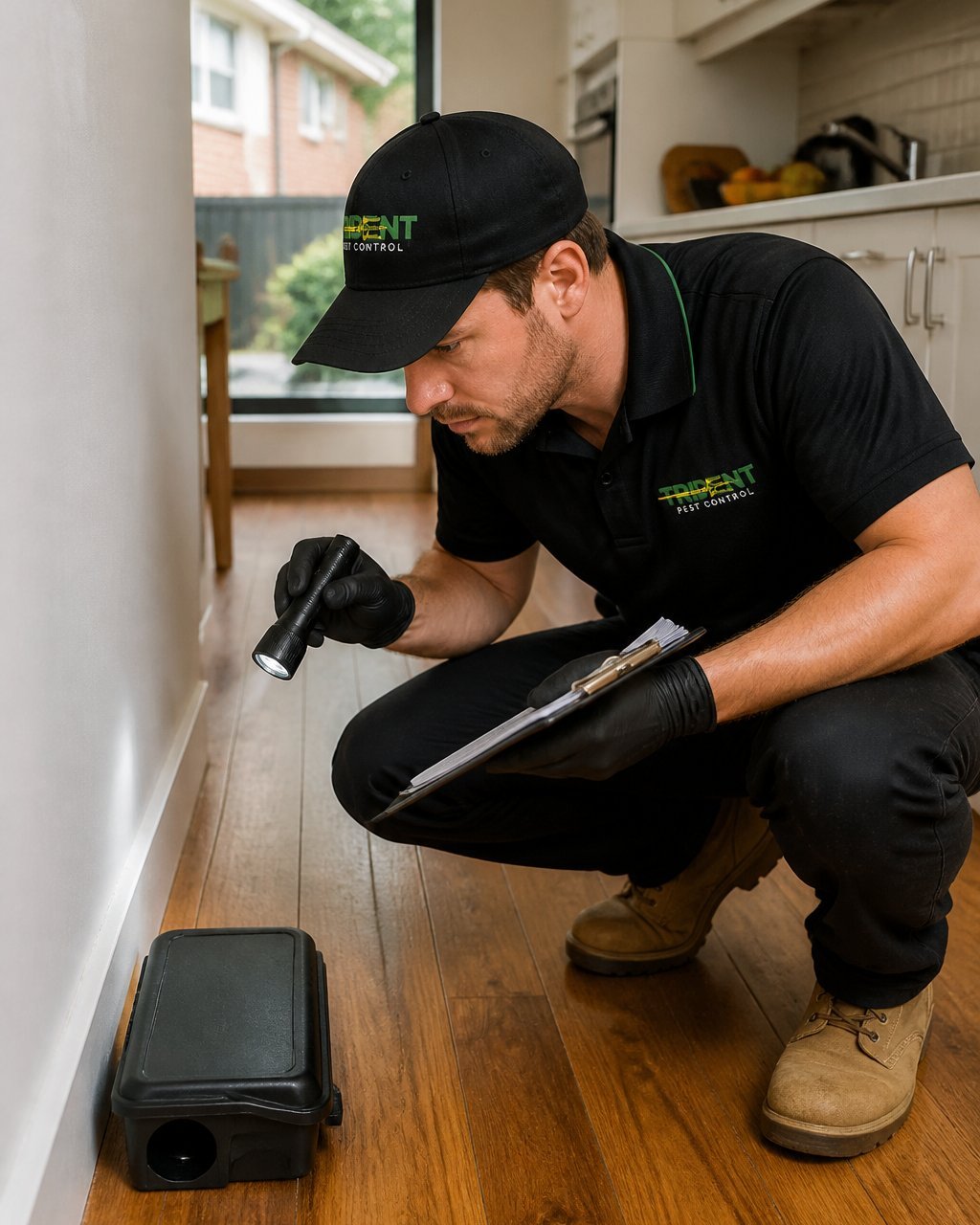
A proper inspection covers the whole building envelope, not just where you’ve seen activity. Technicians check roof voids, subfloor spaces, wall cavities, and the gaps around pipes and cables. A mouse needs only a gap the width of a pencil to squeeze through, which is why sealing matters as much as trapping.
The inspection also identifies what’s attracting rodents in the first place. Pet food left out overnight, compost bins close to the house, and bird feeders all create a reliable food supply. Fix the attraction and the pressure drops.
Ask your technician to photograph and mark every entry point they find. It gives you a checklist to monitor after treatment, and it shows whether sealing work has held up months later.
Safe Rodent Control Around Pets and Children
Safe rodent control around pets and children relies on placement, containment, and choosing methods that keep bait out of reach. This is the concern we hear most from families in Werribee, and it’s a fair one.
The risk with rodenticides isn’t only direct consumption. Pets and small children can also be exposed through secondary poisoning if they catch or chew a rodent that has ingested bait. That risk is why tamper-resistant bait stations exist, and why loose bait should never be scattered in accessible areas.
For households with toddlers, dogs, or cats, the practical approach is:
- Use lockable bait stations secured in roof voids, subfloors, or wall cavities
- Keep traps out of reach and check them daily
- Store all rodent control products in sealed containers away from food
- Confirm with your technician exactly what was used and where
- Follow any re-entry advice given after treatment
Trapping and exclusion work well as a first line of defence in homes with young children and pets, with bait reserved for areas nobody can access. A good technician will talk you through which method suits your household before starting.
Faster Results and Fewer Repeat Infestations
Faster results come from treating the whole property at once rather than chasing rodents room by room. A coordinated plan typically resolves an active infestation in days rather than weeks, and it addresses the cause so the problem doesn’t rebound.
That second part matters more than the first. Anyone can catch a mouse. The real question is why they keep coming back. Repeat infestations almost always trace back to one of three things: an unsealed entry point, an ongoing food source, or a neighbouring property with an untreated problem.
| Problem | DIY Approach | Professional Approach |
|---|---|---|
| Entry points | Often missed | Inspected and sealed |
| Food sources | Rarely addressed | Identified and removed |
| Active population | Partially removed | Treated as a whole |
| Follow-up | None | Scheduled monitoring |
| Recurrence risk | High | Substantially lower |
A recurring infestation usually means the original treatment missed something structural. That’s the difference between a callout and a proper rodent management plan.
Preventing Rodents After Pest Treatment
Prevention after treatment comes down to three habits: sealing, starving, and monitoring. Get those right and most homes stay rodent-free.
Sealing means closing gaps around pipes, vents, and doors with materials rodents can’t chew through. Steel wool and metal flashing work; expanding foam alone usually doesn’t, because rodents chew straight through it. Check weather strips under exterior doors too.
Starving means removing easy meals. Store dry goods in sealed containers, feed pets at set times and pick up bowls afterwards, and keep compost and bins away from the house.
Monitoring means staying alert. Check your marked entry points every few months, watch for fresh droppings, and listen for scratching after dark. Catching a new activity early is far easier than dealing with a full infestation.
If you’d rather not manage that yourself, routine rodent control visits across Werribee and Western Melbourne keep the pressure on year-round, including the cooler months when rodents move indoors.
The Bottom Line on Rodent Pest Management
Rodents are one of the few household pests that genuinely get worse when you ignore them. The benefits of professional pest management for rodents come down to three things: correct identification, treatment that targets the whole population, and exclusion work that stops the next wave from getting in.
DIY traps have their place, and for a single stray mouse they’re often enough. Once you’re seeing droppings in multiple rooms or hearing activity in the roof, you’re past that point.
Trident Pest Control provides licensed and insured technicians, kid and pet-safe treatments, fixed pricing with no hidden charges, and same-day service across Melbourne, Geelong, and Werribee. If you’re dealing with scratching in the walls or droppings in the pantry, get your free quote and we’ll inspect the property, explain what we found, and set out a plan that keeps rodents out for good.
Frequently Asked Questions
What are the benefits of professional rodent pest management?
Professional rodent pest management covers what DIY products cannot: a full inspection to find entry points, correct placement of tamper-resistant bait stations, and a follow-up plan to stop the problem returning. It also reduces the health and property risks rodents create, and technicians handle disposal and cleanup safely. For households in Melbourne’s west, it means one visit that addresses the cause rather than a cycle of traps and repeat sightings.
Is professional rodent control more effective than DIY methods?
DIY traps and baits can catch the occasional mouse, but they rarely solve an active infestation. Rodents learn to avoid traps, and store-bought baits are often placed where children or pets can reach them. A licensed technician identifies the species, maps the runways, and uses methods matched to the situation. The bigger difference is prevention: professionals seal entry points so new rodents cannot move in behind the ones you remove.
Is professional rodent treatment safe for children and pets?
Reputable providers use tamper-resistant bait stations and targeted placement so children and pets cannot access the treatment. Ask the technician exactly what is being used, where it will sit, and how long to keep kids and animals away from treated areas. Trident Pest Control designs treatments around kid and pet safety, and technicians will walk you through the re-entry time before they leave. Always follow the written instructions provided.
How can I prevent rodents from returning after treatment?
Prevention comes down to three things: sealing gaps larger than a ten-cent coin, removing food and water sources, and keeping the exterior clear. Check door seals, weep holes, roof cavities, and pipe penetrations. Store food in sealed containers, fix dripping taps, and trim vegetation back from the walls. Book a follow-up inspection so any new activity is caught early, before it becomes a full infestation again.