Last Updated: November 22, 2026
Quick Summary
To maintain food safety compliance with pest control, run pest prevention as a daily team routine backed by dated records. Check for pest signs each shift, seal entry points, monitor devices weekly, and log every corrective action so inspectors see proof, not promises.
- Check droppings, gnaw marks, grease trails, nests and live sightings on every shift.
- Seal gaps around pipes, doors and windows monthly, since a pencil-width gap admits a mouse.
- Record pest numbers caught per device per period, not just a tick in a box.
- Keep a device map, service reports, inspection records and a corrective action log on file.
- Clear access and cover exposed food before treatment, then clean food-contact surfaces after.
Table of Contents
- Why Pest Control Decides Your Food Safety Compliance
- Know the Signs of Pest Activity Before an Inspector Does
- Your Food Business Pest Control Checklist
- Build a Pest Monitoring and Inspection Schedule That Holds Up
- Pest Control Records for Food Businesses: What Auditors Want
- Writing a Pest Control Corrective Action Plan
- What to Do During and After Pest Treatment
- Book a Compliant Pest Management Visit in Werribee
- Frequently Asked Questions
Why Pest Control Decides Your Food Safety Compliance
Food safety compliance is the practice of meeting your legal duty to keep food free from contamination, and pest control sits at the centre of it. One rodent dropping on a prep bench can shut a kitchen. Council environmental health officers can inspect at any time, and they want proof, not promises.
Businesses that treat pest control as a once-a-year spray often struggle at audit, while those that run it as a daily habit tend to fare better.
Below, we’ll show you exactly how to maintain food safety compliance with pest control, step by step. The seven steps we cover turn a vague worry into a documented system you can hand to an inspector.
But first, here’s what most guides get wrong: they treat pest control as the technician’s job. It isn’t. It’s your team’s job, with a technician supporting it.
Know the Signs of Pest Activity Before an Inspector Does
The most common signs of pest activity in a food premises are droppings, gnaw marks, grease trails, nests, and live sightings. Any one of these means you have a problem worth recording and acting on immediately.
Check these spots on every shift:
- Droppings near wall edges, under shelving, and behind appliances
- Gnaw marks on packaging, cables, and door frames
- Grease rub marks along walls where rodents travel
- Nests in warm, hidden corners and roof spaces
- Live sightings or dead insects in traps and light fittings
A common mistake is waiting for a sighting before acting. By then, an infestation is usually established. For a room-by-room guide, see our signs of rodent activity in Melbourne kitchens.
If you have a council inspection coming up, our council health inspection pest control in Melbourne page explains what inspectors look for.
Your Food Business Pest Control Checklist
A food business pest control checklist is a short, repeatable list your staff work through daily and weekly. It turns pest prevention into routine tasks instead of a scramble before audit.
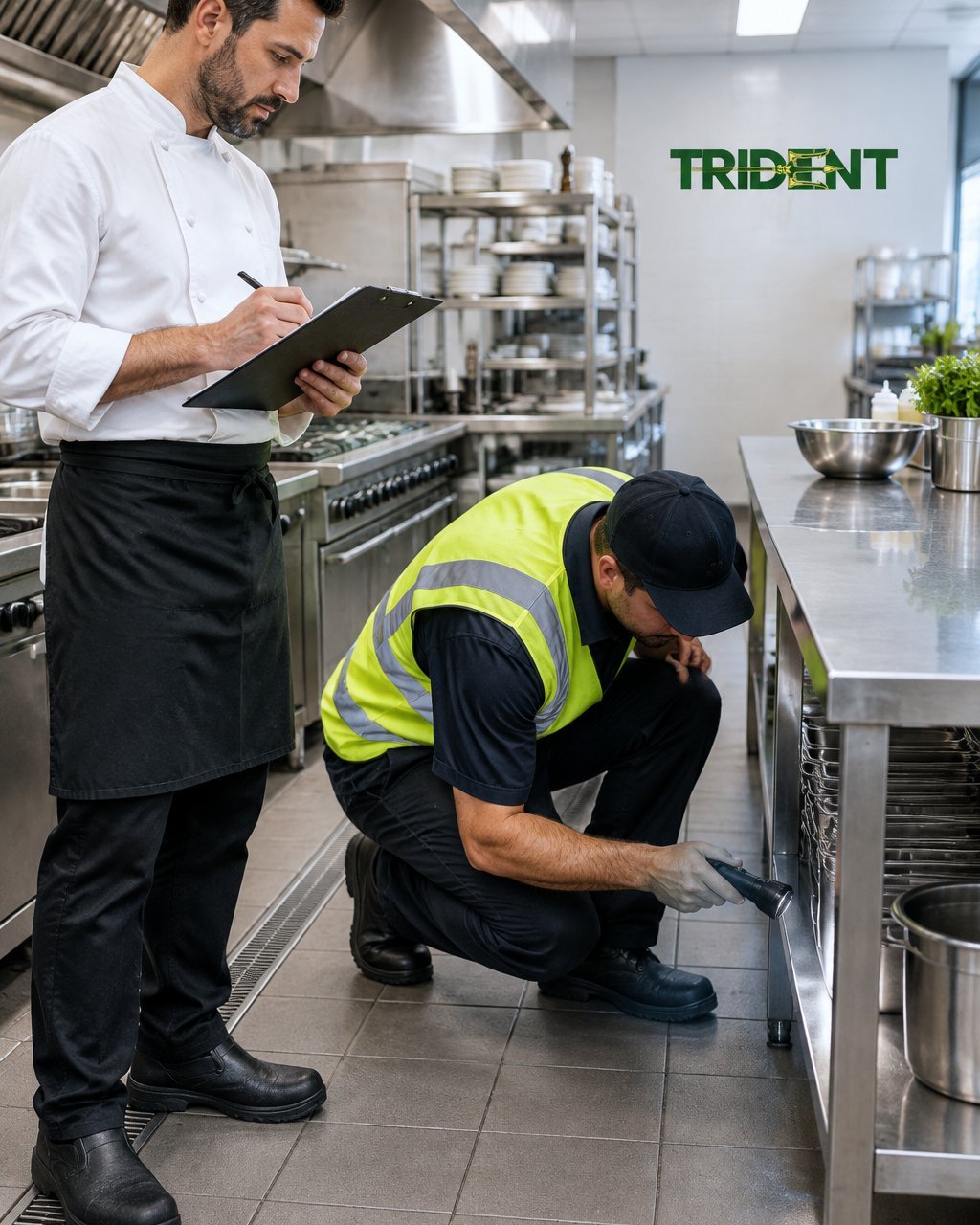
The man is Australian.
Sealing Entry Points and Pest-Proofing the Premises
Walk the outside of your building each month. Seal gaps around pipes, doors, and windows with suitable filler or brush strips. Fit door sweeps, repair torn fly screens, and keep external doors closed.
Watch out: a gap the width of a pencil is enough for a mouse. Check under doors and around service penetrations, because these are the entry points most audits catch.
Food Storage, Waste and Delivery Checks
Store all food in sealed containers off the floor. Clean food preparation areas and surfaces after every task. Empty bins daily, keep lids closed, and move waste to an outside holding area away from doors.
Check every delivery before signing. Reject torn sacks, damp cartons, and anything showing pest damage. Record what you rejected and why.
Build a Pest Monitoring and Inspection Schedule That Holds Up
A pest monitoring and inspection schedule is a written plan setting out what gets checked, by whom, and how often. It holds up at audit because it produces dated records and measurable evidence, not memory.
Use this schedule as a starting point, then adjust frequency to your risk level:
| Task | Frequency | Who | Record produced |
|---|---|---|---|
| Visual check of prep areas, storage and waste | Daily | Shift supervisor | Daily check sheet |
| Bin and waste area check | Daily | Cleaning staff | Cleaning log |
| Entry point walk-around | Weekly | Manager | Weekly inspection note |
| Device check (traps, bait stations, insect light traps) | Weekly | Trained staff member | Device check log |
| Full internal inspection | Monthly | Manager or technician | Signed inspection report |
| Trend review of sightings and device catches | Monthly | Manager | Trend summary |
| Professional service visit | Per contract | Licensed technician | Service report |
Risk-based frequency matters. A premises handling raw food, or one with a history of activity, needs more checks than a low-risk site. Document why you chose your frequencies, because an inspector may ask.
Make Monitoring Measurable
A schedule only holds up if it produces numbers you can review. Record the number of pests caught or sighted per device per period, not just a tick in a box. A trap that catches nothing for months and then catches three rodents in a week is a signal, even though each individual catch looks small.
Review the trend monthly and note any change in a short written summary. If catches rise, increase inspection frequency and investigate the cause before the next service visit.
Watch out: a schedule that is filled in retrospectively, all at once before an audit, is usually obvious from the handwriting and timestamps, and it undermines the whole record set.
If you want an ongoing arrangement, our commercial pest management contracts in Melbourne page shows how scheduled visits work.
Pest Control Records for Food Businesses: What Auditors Want
Pest control records for food businesses are the documents that prove your system works. Auditors want to see a device map, service reports, inspection records, and corrective actions, all dated and signed.
Keep these on file:
- Device map showing where every trap and bait station sits
- Service reports from each technician visit
- Inspection records from your own internal checks
- Corrective action log with what you fixed and when
- Staff reporting notes for any sightings
Digital logs with timestamps are becoming common, and quality assurance coverage of digital pest control tools notes they help with audit readiness and trend reporting. Paper works too. What matters is that the record exists and matches reality.
Writing a Pest Control Corrective Action Plan
A pest control corrective action plan is a short written response to a specific pest problem. It states what was found, what you did, who did it, and how you confirmed the fix.
Write one every time you log pest activity. Use this template:
Corrective Action Record
Date found: __________
Location: __________
What was found: __________
Immediate action taken: __________
Root cause: __________
Prevention step added: __________
Completed by: __________ Date closed: __________
The root cause line is the one most businesses skip. If rodents keep reaching a storeroom, the fix isn’t more traps. It’s sealing the gap they use.
What to Do During and After Pest Treatment
Treatment is the point where food safety risk is highest, because products, equipment and people are all moving around the premises. Treat it as a three-stage workflow: before, during and after.
Before the Visit
Clear access to treatment areas and move stock away from walls so the technician can inspect and treat properly. Cover or remove exposed food, utensils and food-contact surfaces in the areas to be treated. Ask the technician which products will be used and what precautions apply, especially where food handling continues nearby.
Agree in advance who on your team will accompany the technician, who can approve a treatment change, and where the service report will be filed.
During Treatment
Keep staff and customers out of treated areas until the technician confirms it is safe. Do not prepare or serve food in an area being treated. If the technician identifies a problem that needs a decision, such as a bait station relocation or an additional treatment, the nominated manager should approve it and note the decision.
After Treatment
Follow the technician’s instructions on re-entry times. Once the area is cleared for use, clean treated surfaces that come into contact with food before resuming production. Check the treated areas, confirm bait stations are secure and correctly located, and update your device map if anything moved.
Record the service report, note any bait station changes, and log the visit against your corrective action record if a specific problem was treated. Then keep monitoring for renewed activity over the following weeks, because a single treatment does not confirm the problem is closed.
Watch out: resuming food handling in a treated area before the stated re-entry time, or before food-contact surfaces are cleaned, is one of the most common and most serious breaches found at audit.
Food Safety Magazine’s discussion of food safety culture and pest management makes the point that a programme only works when everyone stays vigilant, not just the technician.
Book a Compliant Pest Management Visit in Werribee
Compliance isn’t a document you file once. It’s a routine your team runs every day, backed by a technician who leaves records you can use.
If you’d rather hand the technical side to a licensed team, Trident Pest Control provides pest management across Western Melbourne, with fixed pricing, same-day service availability, and kids and pet-safe treatments.
For food manufacturers needing scheduled support, see our food manufacturing pest control in Melbourne service. Ready to act? Book commercial pest control in Werribee and get your records in order.
Pest problems rarely announce themselves, and an inspection rarely comes with warning. The businesses that pass are the ones with a written system and a technician who documents every visit. Get started with Trident Pest Control and put a compliant, audit-ready pest management routine in place.
Frequently Asked Questions
How does pest control support food safety compliance?
Pest control is a documented requirement in any food safety program. Food safety rules generally expect a food business to take practicable measures to prevent pests entering the premises and to eradicate them if they get in. Inspectors and auditors look for evidence you have done this: a pest management plan, monitoring records, service reports and corrective actions. Without that paper trail, compliance cannot be demonstrated even if your kitchen looks clean on the day.
What pest control records should a food business keep?
Keep the pest management plan and contract, current service reports from your licensed technician, device maps showing bait station and trap locations, your monitoring and inspection log, staff pest sighting reports, and every corrective action you have taken. Store them together so they can be produced quickly at an inspection. Records should show dates, what was found, what was done and who signed off. Digital logs with timestamps make this easier to maintain and to prove.
How often should a food business check for pests?
Set a frequency that matches your risk. High-risk areas such as dry storage, waste rooms and loading docks warrant weekly checks of bait stations and traps, while a full documented inspection is commonly done monthly. Your pest controller’s routine visits should sit alongside these internal checks. After any sighting, increase checks in that area until activity stops. Record every check, including the ones where nothing was found, because a consistent log is what demonstrates diligence to an auditor.
What should staff do if they find signs of pests near food?
Staff should stop work in that area, isolate or discard any exposed food, and report it to the food safety supervisor immediately. Do not spray pesticides near food or food contact surfaces; that is a job for a licensed technician. Record the sighting with the date, location and what was seen, then log the corrective action taken. Clear staff reporting channels are one of the most reliable early-warning systems a food business has, and the report itself is valuable audit evidence.
