
Table of Contents
- What Pest Control in St Albans Actually Covers
- Common Household Pests Victoria Homeowners Deal With
- How to Prevent Spider Infestations in St Albans
- Termite Inspection St Albans: What the Process Involves
- Choosing a Pest Control Provider in St Albans
- Safe Treatments for Kids and Pets
- Frequently Asked Questions
Last Updated: September 23, 2026
What Pest Control in St Albans Actually Covers
Pest control in St Albans is the targeted management of insects, spiders, rodents and termites inside and around a property, using licensed treatments matched to the pest and the building. It is not a single spray-and-leave job. At Trident Pest Control, we treat it as three separate problems: what is living in your walls, why it got in, and how to stop it returning.
That distinction matters more than most homeowners realise. Australia is one of the most urbanised nations in the world, and its cities are growing fast, which makes sustainable urban pest management a genuine public health priority rather than a niche concern (NCBI research on urban pest management).
St Albans sits in Melbourne’s north-west, an area of older weatherboard homes, established gardens and heavy rental turnover. All three create pest pressure. This guide from Trident Pest Control breaks down what local homeowners actually face, how termite inspections work, and how to choose a provider without getting burned.
Common Household Pests Victoria Homeowners Deal With
The most frequent call-outs across Victoria are ants, spiders, cockroaches, rodents and termites. Each behaves differently, and treating them as one generic problem is why infestations keep coming back.
Ants trail along skirting boards and kitchen benches, usually entering through the smallest exterior gaps. Cockroaches favour warm, damp voids behind appliances. Rodents follow food and shelter, and in older homes they often move in through roof cavities. Spiders are the pest Victorian homeowners most often want gone on sight, but they are also the easiest to deter with the right exterior barrier.
Termites are the expensive one. They work silently, and by the time you notice damage the colony has usually been active for a long time.
| Pest | Typical Entry Point | Warning Sign | Treatment Approach |
|---|---|---|---|
| Ants | Exterior cracks, skirting | Trails near food prep areas | Targeted gel and perimeter barrier |
| Cockroaches | Behind appliances, drains | Droppings, musty odour | Crack and crevice treatment |
| Rodents | Roof cavity, wall gaps | Scratching at night, droppings | Baiting plus exclusion work |
| Spiders | Eaves, windows, garden edges | Webs on external surfaces | External residual barrier |
| Termites | Soil contact, timber joins | Mud tubes, hollow timber | Inspection then managed treatment |
Treating ants with a supermarket surface spray often makes things worse. It kills the workers you can see but leaves the colony intact, and the survivors frequently relocate deeper into the wall cavity.
How to Prevent Spider Infestations in St Albans
Preventing spider infestations in St Albans comes down to removing the sheltered, insect-rich zones spiders rely on, then sealing the routes they use to get inside.
Redbacks and huntsmen are common in this part of Melbourne. Both prefer quiet, undisturbed spots: under eaves, behind stored timber, in garden clutter and along fence lines. Reducing those harbourage points does most of the work.
Practical steps that make a measurable difference:
- Clear leaf litter and stored materials away from external walls
- Trim plants back so they are not touching the cladding or roofline
- Seal gaps around windows, doors and weep holes with appropriate mesh
- Switch external lighting to warm or yellow globes to attract fewer insects
- Knock down webs weekly during peak season, which is late spring through autumn
What most guides miss is that spiders follow their food supply. If your exterior is full of insects, you will keep getting spiders no matter how often you sweep webs away. An external residual barrier breaks that cycle.
Focus treatment on the exterior perimeter rather than indoors. Interior spraying disrupts spiders temporarily but does nothing about the population living in your garden and eaves.
Termite Inspection St Albans: What the Process Involves
A termite inspection in St Albans is a systematic check of the property’s timber, soil contact points and subfloor for live activity, damage and conditions that invite termites. A standard inspection covers the roof void, subfloor, interior, exterior and any outbuildings.
The process usually runs in three stages. The technician inspects accessible areas and records findings. They then identify likely entry points and moisture problems, since termites need both. Finally, you get a written report with photographs and recommendations.
A few things worth knowing before you book:
- Inspections are visual and non-invasive. They do not involve drilling or cutting.
- Access matters. Blocked subfloor vents or a packed roof cavity limit what any inspector can see.
- Frequency counts. Many homeowners find annual checks are the practical minimum in established suburbs.
- A report identifies the problem. Fixing damage and installing a management system are separate steps, and you should ask upfront whether one provider handles both.
If you are buying in Werribee or Geelong and an inspection has flagged possible termite damage, the right question is not “is there damage” but “where is it coming from and is it still active.” A proper inspection answers both.
Choosing a Pest Control Provider in St Albans
The best pest control provider in St Albans is one that is licensed, insured, quotes a fixed price before starting, and can explain what it will apply and why. Everything else is secondary.
Price alone tells you very little. A cheaper service that uses a single broad treatment will often need repeat visits, and the total cost ends up higher. What separates providers is diagnosis.
Use this checklist when comparing quotes:
- Licence number provided on request
- Current public liability insurance confirmed
- Written fixed quote with no conditional extras
- Clear explanation of the treatment and active ingredients used
- Written advice on re-entry times for children and pets
- Follow-up or warranty terms stated in writing
- Same-day or emergency availability confirmed, not implied
“Near me” searches are how most people find pest control, and that is actually the right instinct. Local operators know the housing stock, the soil and the seasonal pest patterns in their area. A technician who works across Werribee, Geelong and Melbourne’s west every week has seen your exact problem before.
Ask any provider what happens if the pest returns inside the warranty period. A confident, written answer is the single clearest signal you are dealing with a professional operation.
Safe Treatments for Kids and Pets
Kid and pet-safe pest treatments work by targeting the pest’s biology and placement rather than by being weaker. The products used are registered for domestic use, and the technician’s job is to apply them where children and animals cannot reach them.
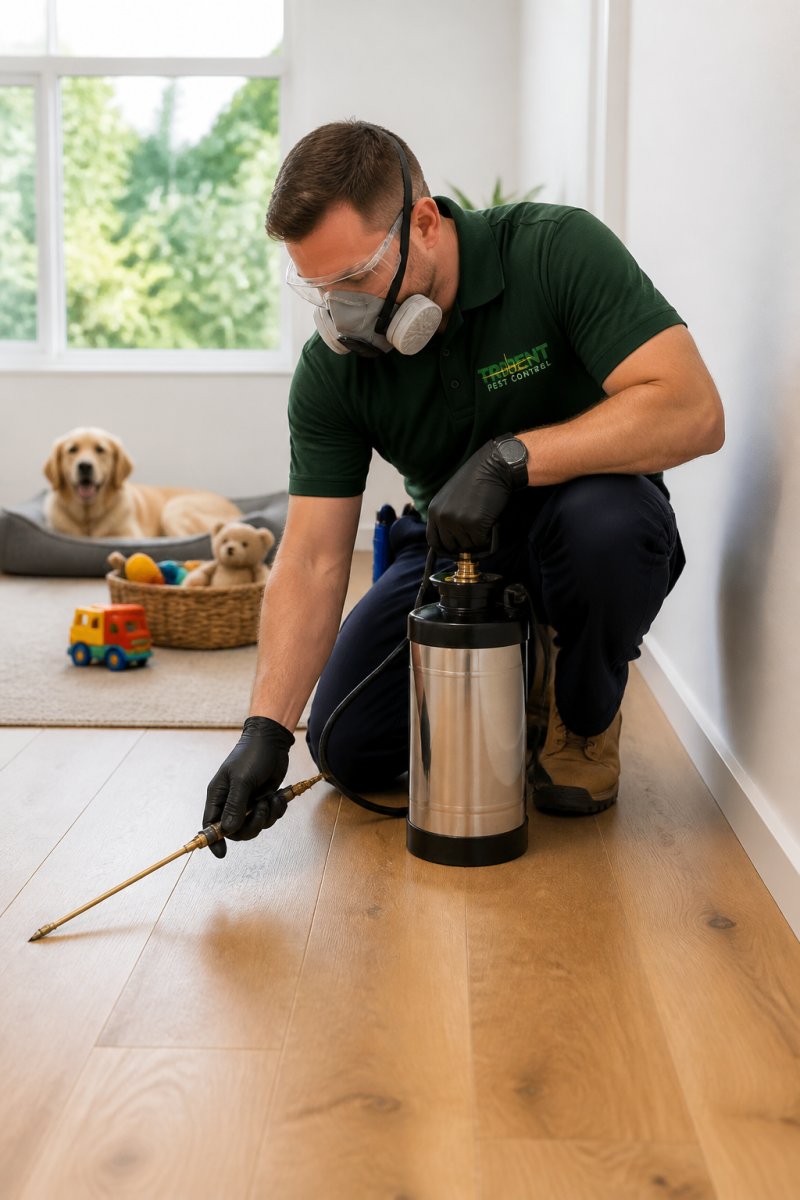
The honest answer to “what exactly goes into these treatments” is that it depends on the pest. Ant gels, rodent baits and residual barriers all use different actives, and a good technician will tell you which one is going on your property and where. Proactive measures remain the most effective way of preventing rodent infestations before these targeted chemical interventions become a necessity.
Re-entry time is the question we get most. It varies by product and application method, and the technician should give you a specific time in writing before they pack up, not a vague “give it a few hours.” Follow that instruction exactly.
A few practical rules that hold across most treatments:
- Keep pets and children off treated surfaces until the stated drying time has passed
- Move food, bowls and pet bedding out of the treatment area beforehand
- Ventilate the property once re-entry is permitted
- Store the written treatment record somewhere you can find it later
If a provider cannot explain the active ingredients and the re-entry period clearly, that is your answer about whether to book them.
Frequently Asked Questions
How often should I get pest control for my home in St Albans?
Most homes in St Albans benefit from a professional treatment once a year, timed before the warmer months when ants, spiders and cockroaches become more active. Properties near parks, waterways or new developments may need six-monthly visits. If you have had rodents or a heavy cockroach problem, quarterly checks for the first year help confirm the issue has cleared. Ask your technician to set a schedule based on your pest history and the age of your home.
Are pest control treatments safe for pets and children?
Registered treatments applied by licensed technicians are safe for households with children and pets when the label directions are followed. Your technician will tell you exactly how long to keep everyone off treated surfaces, which is usually until the product dries. Ask for a written safety sheet listing the products used. If anyone in the home has asthma or chemical sensitivities, mention it when booking so the technician can adjust the approach.
How do I know if I have a termite infestation in St Albans?
Warning signs include mud tubes on foundations, hollow-sounding timber, bubbling paint, and flying termites near windows in spring. Termites often leave no visible damage until an infestation is advanced, which is why annual inspections matter. A professional inspection checks the subfloor, roof void, fences and garden timbers using moisture meters and sounding tools. If activity is found, you receive a report identifying the species, the entry points and recommended treatment options.
What should I do to prepare my home for a professional pest treatment?
Clear benchtops and floors in the kitchen and bathrooms, move pets and their bedding outside or to a closed room, and cover fish tanks before the technician arrives. Store food in sealed containers and remove pet bowls. After treatment, wait for the drying time your technician specifies before wiping surfaces or letting children and pets back into treated areas. Following these steps helps the treatment work as intended and keeps your household safe.
Pest problems in Melbourne’s west rarely fix themselves, and the ones that go untreated get more expensive. Trident Pest Control works across Werribee, St Albans, Geelong and surrounding suburbs with licensed and insured technicians, fixed pricing and no hidden charges, and kid and pet-safe treatments as standard. Same-day service is available when you need it. Get your free quote from Trident Pest Control and get the problem identified properly the first time.