
Table of Contents
- Start With the Outside of the House
- Signs of Mice in the House That Point to an Entry Point
- Your Room-by-Room Rodent Inspection Checklist
- How to Seal Gaps to Keep Mice Out
- How to Tell Whether a Gap Is Actually Being Used
- When to Call a Professional About Rodent Entry Points
- Frequently Asked Questions
Last Updated: October 9, 2026
Start With the Outside of the House
Most rodent problems start outside. If you want to know how to identify rodent entry points in your house, walk the perimeter first. That’s where the gaps are, and that’s where the trail begins.
At Trident Pest Control, we inspect homes across Werribee and the wider western suburbs, and the pattern rarely changes. Rodents follow warmth, food and shelter. Your job is to find the route they use to get all three.
Here’s what to check on the outside:
- Gaps under doors, especially garage and laundry doors
- Cracks in brickwork near the base of the wall
- Holes where pipes, cables and air conditioners pass through
- Loose roof tiles and gaps under eaves
- Vents and weep holes without mesh covers
A mouse can squeeze through a gap the width of a pencil. So don’t skip anything that looks too small to matter.
Stand back and look at the whole wall. Look for rub marks, droppings or grease trails along the base. Those smudges are where fur has brushed against the surface over and over.
That’s your first clue. Now you know roughly where to look inside.
Signs of Mice in the House That Point to an Entry Point
The clearest signs of mice in the house are droppings, gnaw marks, greasy rub marks and a musky smell. Each one tells you something different about where the rodents are coming in and how long they’ve been there.
Droppings are the giveaway. Fresh droppings are dark and soft. Old ones are grey and brittle. If you find them in a line along a wall, the rodents are running that route.
Gnaw marks matter too. Rodents chew to keep their teeth worn down. Look for damage on skirting boards, food packaging, cables and pipe insulation.
Here’s how to read the common signs:
| Sign | What It Means | Where to Look |
|---|---|---|
| Droppings | Active trail along a wall | Corners, behind appliances |
| Gnaw marks | Recent feeding or nesting | Skirting, cables, packaging |
| Rub marks | Repeated travel route | Wall bases, door frames |
| Musky smell | Established infestation | Cupboards, roof space |
| Nests | Breeding site | Insulation, stored boxes |
One sign on its own proves little. Three or more together means you’ve found a working entry point.
Don’t clean up droppings with a bare vacuum or broom. Rodent waste can carry disease, and sweeping sends dust into the air. Wear gloves and a mask, and damp the area before you clean.
Your Room-by-Room Rodent Inspection Checklist
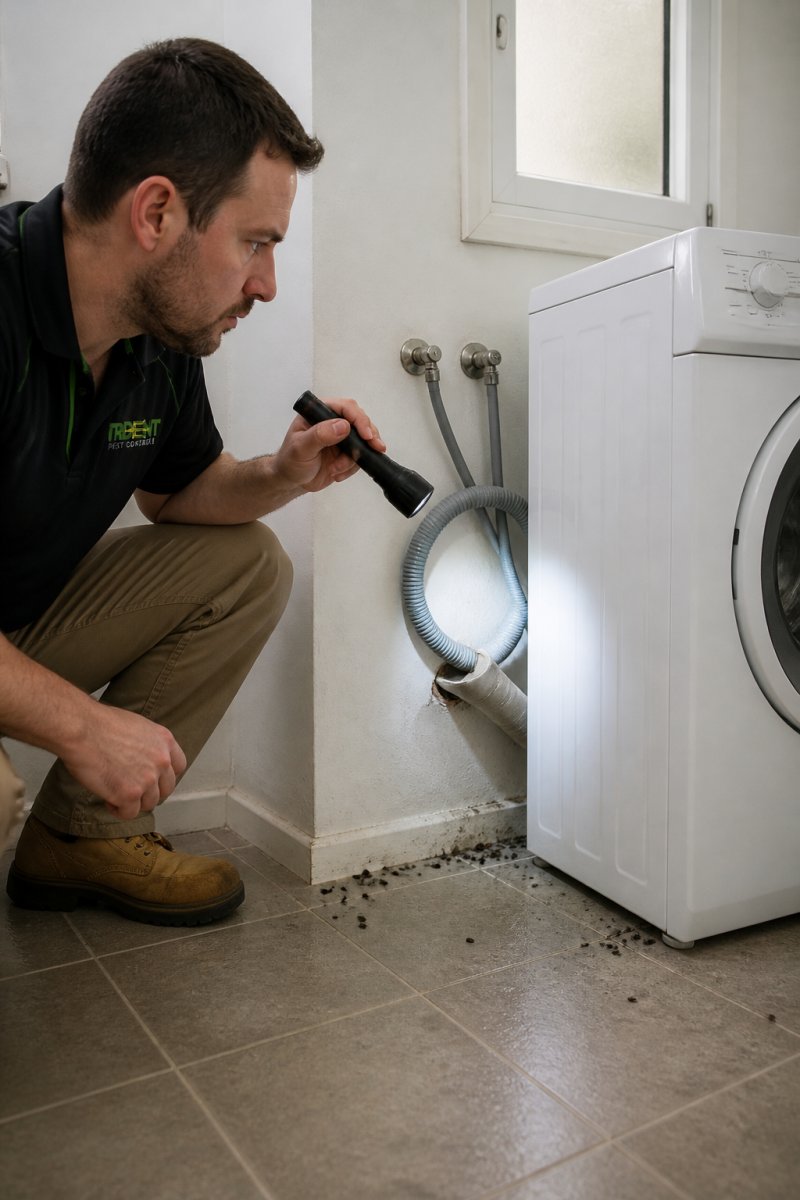
A rodent inspection checklist keeps you from missing the obvious. Work through each room in order, and note what you find. This is the part most people rush, and it’s why they miss the entry point.
Grab a torch and a notepad. Check low first, then high.
While you are inspecting the exterior foundations for these gaps, take a moment to look upward and spot storm damage that may have compromised the roofline and created new access points for pests.
Kitchen and Pantry
The kitchen is where food lives, so it’s where rodents spend their time. Pull out the fridge and the oven. Look behind the dishwasher.
Check these spots:
- Gaps behind the stove and fridge
- Holes where pipes enter the wall under the sink
- Chewed corners on cereal boxes and flour bags
- Droppings on top of the wall cupboards
- Gaps along the kickboard under cabinets
If you find droppings near a pipe hole, that hole is a strong suspect.
Roof Space, Garage and Laundry
The roof space is the easiest place for rodents to enter and the hardest to spot. Climb up with a torch and check the insulation for tunnels and nests.
In the garage and laundry, focus on the service points:
- Gaps around hot water systems and pipes
- Chewed cardboard and stored boxes
- Droppings along the wall base
- Gaps under the external door
- Open vents without covers
Garage doors are a common weak spot. The gap along the bottom edge is often wider than it looks.
How to Seal Gaps to Keep Mice Out
Sealing gaps is the only permanent fix. Traps and baits remove the rodents you have. Sealing stops the next lot from getting in.
Match the material to the gap:
| Gap Type | Best Material | Why |
|---|---|---|
| Small cracks | Wire mesh plus sealant | Rodents can’t chew metal |
| Pipe entry points | Coarse steel wool plus sealant | Fills odd shapes |
| Door gaps | Door seal or brush strip | Stops the daily run |
| Large holes | Cement or mortar | Solid and permanent |
Steel wool works because rodents won’t chew through it. Plain expanding foam does not. They chew straight through foam in a night.
Push steel wool into the gap, then cover it with sealant. That gives you a barrier that holds.
Stuff the gap tightly. A loose fill leaves small channels, and a determined mouse will find them. Pack it so there’s no wiggle room at all.
How to Tell Whether a Gap Is Actually Being Used
Not every gap is an entry point. To test one, clean the area first. Wipe away any droppings, dust and rub marks, then check back in a few days.
If fresh droppings or new rub marks appear, the gap is live. If it stays clean, it’s probably just an old opening.
A few other tests help:
- Place a light dusting of flour at the gap and look for tracks
- Check for fresh gnaw marks on the edges
- Look for smudges where fur brushes the surface
- Listen at night for scratching or scurrying
Do this for each suspect gap before you seal it. Sealing a live entry point with a rodent still inside just traps it in your walls.
That’s a smell you don’t want. So confirm first, then seal.
When to Call a Professional About Rodent Entry Points
Call a professional when you’ve sealed the obvious gaps and the rodents keep coming back. That usually means there’s a second entry point you haven’t found, or the infestation is well established.
Some jobs are best left to a licensed technician:
- Roof spaces with heavy nesting
- Wall cavities with active trails
- Repeated infestations after DIY attempts
- Homes with young kids or pets
Trident Pest Control handles rodent control across Werribee and the western suburbs. Our licensed and insured technicians find the entry points, treat the infestation and seal the gaps. We use kid and pet-safe methods, with fixed pricing and no hidden charges.
If you’re searching for rodent control near me in Werribee, that’s exactly the work we do. Same-day service is available when you need it fast.
Finding the entry point matters more than catching the rodent. Seal the gap and you solve the problem for good. Skip it and the next mouse walks straight back in.
Frequently Asked Questions
What size hole can a mouse squeeze through?
A mouse can fit through a gap roughly the width of a pencil, about 7 mm, which is why weep holes, pipe penetrations and gaps under doors are common rodent entry points. Rats need closer to 20 mm but will gnaw to widen an opening. When you check your home, treat any gap wider than a pencil as a potential entry point and seal it, even if it looks too small to matter.
How do I check walls and cupboards for signs of mice in the house?
Pull appliances away from walls and shine a torch along skirting boards, inside cupboard corners and behind the fridge. Look for droppings, grease smears along wall edges, shredded paper or insulation, and gnaw marks on food packaging. A musty ammonia smell in a closed cupboard is another clue. Record what you find on your rodent inspection checklist so you can track activity over the following week.
What should I do after finding a rodent entry point?
Photograph the gap, note its location, then clean up any droppings while wearing gloves and a mask, and disinfect the area. Seal the gap with steel wool or copper mesh plus a suitable sealant, or have it repaired professionally. Set traps nearby to catch rodents still inside, and recheck the spot after a week. If activity continues, a licensed technician can confirm whether you missed a secondary entry point.
Can rodents get in through roof spaces or vents?
Yes. Roof voids, eaves, whirlybirds and subfloor vents are among the most common ways rodents enter Australian homes, especially where trees or vines touch the roofline. Check inside the roof space with a torch for droppings, tunnelled insulation and rub marks on timber. Fit mesh over vents and repair torn fascia or loose roof tiles. In older homes, gaps around plumbing penetrations in the ceiling are also worth sealing.
Rodents will always look for a way in. The trick is making sure there isn’t one. If you’ve checked the gaps, read the signs and still can’t find the entry point, that’s where we come in. Trident Pest Control offers licensed technicians, kid and pet-safe treatments and fixed pricing with no hidden charges. Get your free quote and let us seal the gaps for good.