Last Updated: November 12, 2026
Quick Summary
Professional pest management compliance standards combine mandatory legal duties, Australian Standards and documented operating practices that prove pest control work was planned, performed and recorded correctly. Every compliant program rests on a licensed, insured technician, approved chemicals applied at label rates, and inspection findings, treatments and corrective actions that are documented and retained.
- Legislation is mandatory, Australian Standards are usually voluntary unless a contract or regulation calls them up, and certification is a commercial choice.
- Ask for the licence number, check it against the public register, and request a certificate of currency for insurance before anyone arrives on site.
- Site risk, not business size, should drive how often a property is inspected and how much documentation is produced.
- Re-entry time is set by the chemical label and the technician’s written advice, never by a generic rule of thumb.
- An audit-ready report shows what was found, what was done, what was corrected and who verified it.
Table of Contents
- What Professional Pest Management Compliance Standards Actually Require
- Legislation, Australian Standards and Certification: What Is Mandatory and What Is Voluntary
- Pest Control Licensing Victoria: How to Verify a Provider’s Credentials and Insurance
- Compliance by Business Type and Site Risk
- Pest Treatment Safety Precautions Before, During and After Service
- Pest Control Treatment Re-Entry Time and What It Means for Families and Staff
- Building an Audit-Ready Pest Control Service Report Template
- Booking a Compliant Pest Management Program in Werribee
- Frequently Asked Questions
What Professional Pest Management Compliance Standards Actually Require
Professional pest management compliance standards are the combination of legal duties, Australian Standards and documented operating practices that a business must meet to prove pest control work was planned, performed and recorded correctly.
Three obligations sit underneath every program in Werribee and across VIC:
- A licensed, insured technician performs and records the work
- Treatments use approved chemicals at label rates, with safety directions followed
- Inspection findings, treatments and corrective actions are documented and retained
Miss any one of those and the treatment itself becomes almost irrelevant. The program fails on evidence, not on pests.
Legislation, Australian Standards and Certification: What Is Mandatory and What Is Voluntary
Legislation is mandatory, Australian Standards are usually voluntary unless a contract or regulation calls them up, and certification is a commercial choice.
The legal layer comes from three streams that apply in Werribee and across Victoria:
- Public health law, Victorian public health legislation gives councils powers to investigate pest-related nuisances and, in defined cases, require notification and control. Local councils administer these powers through their environmental health officers. Check the current Acts and Regulations on the Victorian legislation website.
- Pesticide control, the Agricultural and Veterinary Chemicals (Control of Use) Act 1992 (Vic) and its regulations govern who may use pesticides, how they are stored and applied, and what records must be kept. Agriculture Victoria chemical use guidance sets out the record-keeping and label-compliance duties.
- Workplace safety, Victorian occupational health and safety legislation requires risk controls, chemical registers and safe systems of work wherever pesticides are handled.
On top of the state layer sit Commonwealth rules administered by the Australian Pesticides and Veterinary Medicines Authority (APVMA), which registers products and approves their labels.
The standards layer is where most confusion lives. AS 3660 covers termite management and is commonly referenced in property transactions, but it is not a general pest control rulebook. AS/NZS 4801 and ISO 45001 address safety management systems rather than pests.
| Layer | Status | Who enforces it | Typical evidence |
|---|---|---|---|
| Victorian Acts and Regulations | Mandatory | Councils, Agriculture Victoria, WorkSafe Victoria | Licence, notifications, chemical records |
| APVMA label directions | Mandatory | APVMA, state regulators | Product label, application record |
| Australian Standards | Voluntary unless referenced | Client contract or auditor | Scope statement, method notes |
| Industry certification | Voluntary | Certification body | Audit certificate, program manual |
A practical way to read the hierarchy: ask of any document “who can penalise me if I ignore it?” If the answer is a regulator, it is law. If the answer is a client or an auditor, it is contractual.
Watch out: a provider who quotes “AS 3660 compliant” as if it were a legal requirement is either misreading the framework or overselling, ask which regulation or contract clause calls the standard up before you accept the claim.
Pest Control Licensing Victoria: How to Verify a Provider’s Credentials and Insurance
Ask for the licence number, check it against the public register, and request a certificate of currency for insurance before anyone arrives on site. Verification takes minutes and protects you from liability if something goes wrong during treatment.
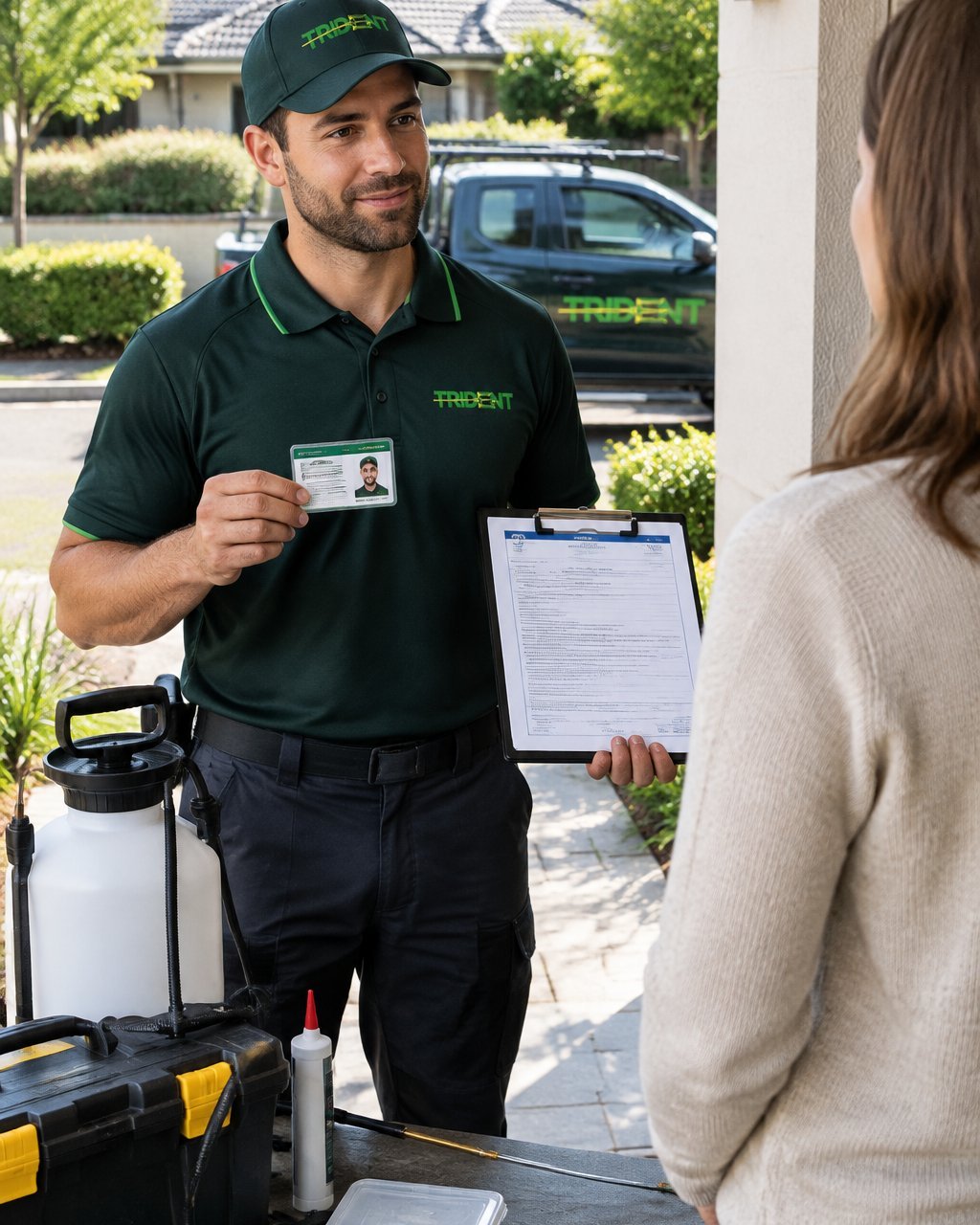
A practical check, in order:
- Confirm the business holds a current pest control licence for the categories being treated
- Match the licence name to the trading name on the quote
- Ask for public liability cover and confirm the expiry date
- Confirm the technician attending is trained and supervised under that licence
- Get the treatment method and chemical names in writing before the visit
A licensed sole trader subcontracted by an unlicensed booking platform leaves you with no clear responsible party. Watch out: if the person quoting cannot produce a licence number on request, stop there. Once a responsible party is clear, apply the same care to site obligations, since commercial grounds compliance depends on defined duties as well as licensed work, including where Terra Maintenance is involved.
Compliance by Business Type and Site Risk
Site risk, not business size, should drive how often a property is inspected and how much documentation is produced. A childcare centre, a restaurant and a warehouse share the same legal baseline but need very different monitoring intensity, and the gap between them is where most compliance failures occur.
Risk should be scored on four inputs: pest pressure from the surrounding environment, the consequence of a pest incursion (contamination, injury, reputational damage), the accessibility of the site for inspection, and the history of activity on that specific property. A Werribee food premises backing onto a green corridor scores differently from an identical premises in an industrial estate, even though the law treats them the same.
| Site type | Inspection rhythm | Documentation depth | Key risk driver |
|---|---|---|---|
| Restaurant or cafe | Monthly | Full service report, corrective actions, re-entry records | Contamination and food handling |
| Childcare centre | Monthly to quarterly | Safety data, re-entry records, parent communication log | Vulnerable occupants |
| Healthcare and aged care | Monthly | Audit trail, restricted-area access notes, incident log | Vulnerable occupants, accreditation |
| Warehouse or factory | Quarterly | Monitoring maps, trend analysis, pallet and racking notes | Product and stock loss |
| Strata and residential rental | At service and lease end | Treatment record, safety advice | Shared responsibility, turnover |
Hospitality and food handling sites carry the highest scrutiny because pest activity and food contamination are directly linked. Operators wanting a program shaped around their kitchen and storage layout can look at restaurant pest control tailored to compliance and site risks.
Childcare and healthcare settings add child-safe and vulnerable-person considerations, and in aged care the pest program is often reviewed alongside accreditation evidence, so the service report needs to be legible to a non-specialist auditor.
The practical takeaway is that two sites on the same street can justify different inspection rhythms and different documentation depth. A provider who quotes the same quarterly program to a childcare centre and a warehouse may not have assessed your risk. Ask for the risk assessment that produced the schedule, and check that it names the specific pressure points on your site.
Pest Treatment Safety Precautions Before, During and After Service
Safety precautions are the instructions that keep children, pets and staff away from treated surfaces until they are dry and settled. They belong in the service report, not just in the technician’s head.
Before service, clear food, utensils and pet bowls from treatment areas and note any respiratory sensitivities. During service, keep people and animals out of the work zone. After service, follow the stated re-entry period and ventilate as directed. Clients who want detail on product safety can read whether pest treatments are safe for pets before booking.
A common mistake is assuming “pet-safe” means “no precautions”. It means the product, dose and placement were chosen to reduce risk, not that the label directions stop applying.
Pest Control Treatment Re-Entry Time and What It Means for Families and Staff
Re-entry time is the interval between treatment and safe return to a treated area, and it varies by product, surface and ventilation. It is set by the chemical label and the technician’s written advice, never by a generic rule of thumb.
For most internal residual treatments, surfaces are ready once dry and ventilated, while some products carry a longer stated interval. Ask for the number in writing. Families with toddlers should treat floors and low cupboards as off-limits until the stated time has passed, and staff in commercial kitchens should keep preparation surfaces covered and cleaned before use.
Re-entry advice is a record too. If a childcare centre cannot show it communicated the interval to parents and staff, the treatment may look undocumented in an audit.
Building an Audit-Ready Pest Control Service Report Template
An audit-ready report shows what was found, what was done, what was corrected and who verified it. If your provider’s report is a single line saying “treated”, you have no compliance evidence at all.
A service report template that holds up should contain:
- Site address, date, technician name and licence number
- Pest activity observed, with location notes or a site map
- Treatment method, product name and application rate
- Safety directions and re-entry time given to the client
- Corrective actions recommended, with owner and due date
- Follow-up inspection date and sign-off
Pest control reports with site maps, trend analysis and corrective actions are what auditors actually want to see. Trend analysis matters most: three consecutive reports showing the same rodent activity tell a far clearer story than one clean visit.
Booking a Compliant Pest Management Program in Werribee
Booking a compliant program means choosing a provider who can show licence, insurance and documentation before the first treatment, then holding them to the same standard on every visit.
In Werribee, the local climate and the mix of older homes, new estates and food businesses create predictable seasonal pressure, so a site-specific program beats a generic quarterly spray. Before you commit, ask for a pest risk assessment that finds entry points and gaps rather than a quote over the phone. That assessment is where compliance starts.
When you are ready to lock in a program with licensed, insured technicians, fixed pricing and clear reporting, you can book a compliant pest management program in Werribee and get the documentation trail set up from visit one.
Compliance is not a treatment you can see working. It is a stack of records that proves the right work happened at the right time, and most pest problems that return are really documentation and follow-up problems.
Frequently Asked Questions
What standards apply to professional pest management in Australia?
Three layers apply. Legislation, including Victorian public health and occupational health and safety law, sets legal duties. Australian Standards, including AS 3660 for termite management, define technical methods. Voluntary certification schemes sit on top and are not law. Ask your provider which layer each claim refers to, because compliance with a standard is not the same as holding a licence.
What licence does a pest control technician need in Victoria?
Technicians who apply pesticides commercially must hold the appropriate Australian Qualifications Framework competency and work under a business that meets Victorian chemical control requirements. Always ask for the licence number and check it against the public register before booking. A provider that cannot produce a number on request is not demonstrating pest control licensing Victoria requirements, regardless of what the quote says.
How long should people and pets stay away after pest treatment?
Pest control treatment re-entry time depends on the product, the method and the area treated. Your technician must state it on the service report before they leave. Follow that figure exactly, keep children and pets off treated surfaces until it passes, and ventilate the space as directed. If no re-entry time is given in writing, ask for it before the technician packs up.
What records should a professional pest management service provide?
A complete pest control service report template should capture the date, technician name and licence number, pests targeted, products used with label rates, areas treated, re-entry time, monitoring findings, corrective actions and the next inspection date. Keep these records for at least the period your insurer or auditor requires. They are your evidence if a complaint, claim or compliance audit arises later.
How can I check whether a pest management provider is licensed and insured?
Ask for the licence number and the certificate of currency for public liability insurance, then verify both independently rather than accepting a logo on a website. Confirm the policy covers the type of work being quoted, and check the expiry date. For commercial sites, request a copy for your records so pest management compliance can be demonstrated during an audit.
