
Table of Contents
- How to Identify Rodent Entry Points in Your Home: Start With the Signs
- The Rodent Entry Point Inspection Checklist for Every Room
- Common Rodent Entry Points in Melbourne and Geelong Homes
- Best Materials to Seal Rodent Holes (and What Rodents Chew Through)
- Why DIY Inspection Misses Hidden Entry Points
- When to Call a Licensed Pest Controller in Werribee and Western Melbourne
- Conclusion: Seal the Gaps, Then Stay Vigilant
- Frequently Asked Questions
Last Updated: October 4, 2026
How to Identify Rodent Entry Points in Your Home: Start With the Signs
Rodents leave a trail before you ever see one. Droppings, grease marks, and nighttime scratching are the earliest clues, and learning to read them is the fastest way to work out how to identify rodent entry points in your home. At Trident Pest Control, we inspect homes across Werribee and Western Melbourne every week, and the pattern is always the same: the evidence shows up first, the hole shows up later.
Rodent entry points are any gap, crack, or opening a rat or mouse can squeeze through to get inside a building. Mice need a gap about the width of a pencil. Rats need roughly the size of a twenty-cent coin.
That is the part most people get wrong. They picture a wide-open hole and ignore the thin gap under a door.
Droppings, Grease Marks and Urine Trails
Droppings are the clearest sign of rodent infestation in house settings. Fresh droppings are dark and soft. Old ones are grey and brittle.
Look along skirting boards, inside cupboards, and behind the fridge. Rodents hug walls, so the mess collects in corners, not the middle of the room.
Grease marks are the second clue. Rodents have oily fur. When they squeeze through the same gap night after night, they leave a dark smear on the edge. Run your fingers along a suspected gap and check for a waxy feel.
Urine trails glow under UV light. Pest controllers use this to trace the exact path a rodent takes from entry point to food source.
Scratching, Scurrying and Night Noises in Walls and Ceilings
Sound tells you where to look. Scratching in the walls at night usually means rodents moving through the wall cavity.
Listen for three different noises:
- Scratching: claws on timber or plaster, often in the roof space
- Scurrying: fast light footsteps across a ceiling
- Gnawing: a steady grinding sound, usually near wiring or pipes
Rodents are most active just after dark and just before dawn. Sit still in a quiet room during those windows and note which wall or ceiling the sound comes from.
That gives you a starting point for the inspection.
The Rodent Entry Point Inspection Checklist for Every Room
A room-by-room inspection takes about an hour in an average home. Work from the outside in, and check every gap with a torch and a mirror so you can see behind pipes and under eaves.
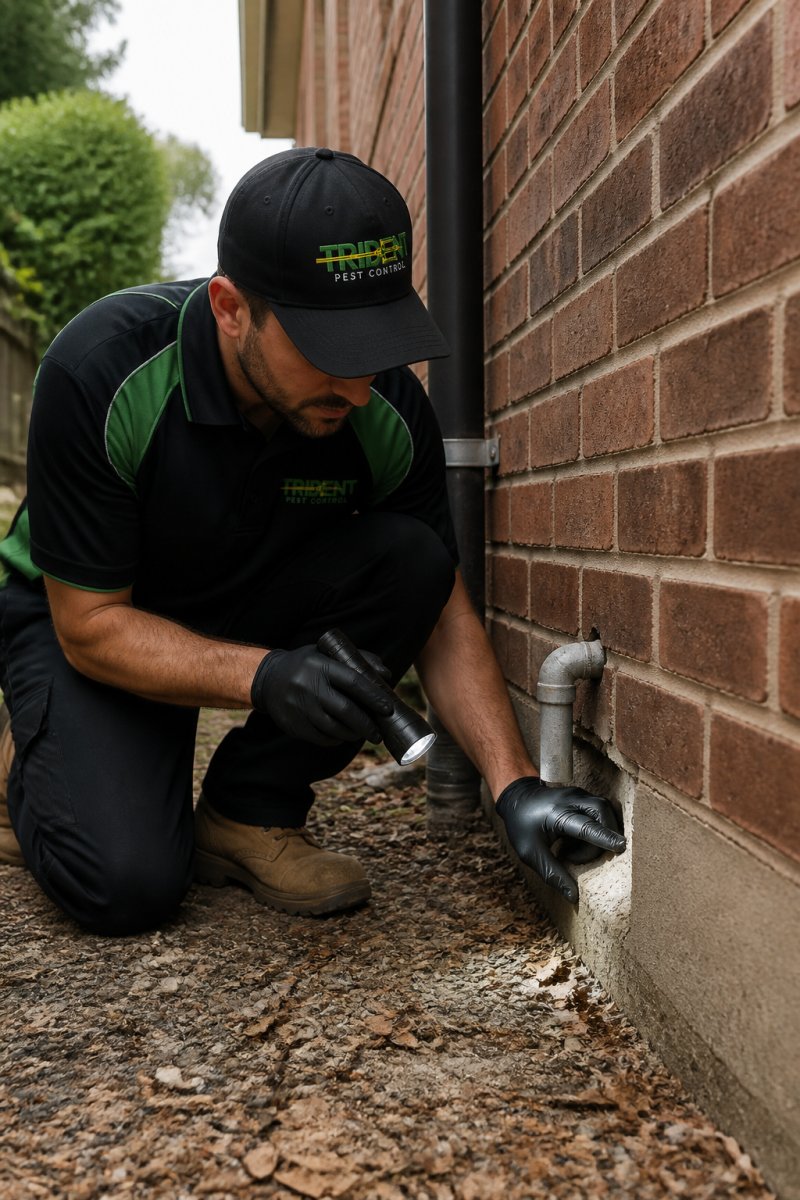
Rodents follow structural voids, plumbing runs, and protected edges. That habit makes certain spots far more likely than others, as pest control technicians note in industry discussion on r/pestcontrol.
Outside the House: Roof, Gutters and Foundation Line
Start at the roofline. Check these spots:
- Broken roof tiles and lifted flashing
- Gaps where gutters meet the fascia
- Openings under eaves and soffits
- Cracks in brickwork at the foundation
- Gaps around pipes, cables, and air conditioning lines
Trees and vines touching the roof give rodents a bridge straight onto your home. Trim them back.
Inside the House: Kitchen, Laundry, Garage and Roof Space
Inside, focus on warmth and water. Check under the sink, behind the dishwasher, and around the laundry taps.
In the garage, look at the bottom corners of the roller door. In the roof space, follow the plumbing runs and check where pipes pass through the ceiling.
Use this checklist:
- Droppings along skirting boards and in cupboards
- Grease smears on wall edges and pipes
- Gnaw marks on timber, wiring, or food packaging
- Gaps wider than a pencil under doors
- Cracks around pipe entries and vents
- Nests made of shredded paper, insulation, or fabric
Common Rodent Entry Points in Melbourne and Geelong Homes
Older brick homes in Melbourne and Geelong share the same weak spots. The most common are roof returns, soffit gaps, and utility penetrations where pipes and cables enter the wall.
Weepholes in brick veneer are another favourite. They are meant to let moisture out, but a determined mouse will use them as a doorway.
Homes near Werribee’s open grassland and creek corridors see more rodent pressure than inner-city blocks. There is simply more habitat next door.
If you are searching for rodent control near me in Werribee, the first step is always the same inspection.
Best Materials to Seal Rodent Holes (and What Rodents Chew Through)
The best materials to seal rodent holes are steel wool, metal mesh, and concrete or mortar. Rodents chew through foam, plastic, and timber with ease, so those materials only buy you time.
Match the material to the gap:
| Gap Type | Best Material | Why It Works |
|---|---|---|
| Pipe penetrations | Steel wool plus sealant | Rodents cannot chew steel |
| Wall cracks | Mortar or cement | Hardens solid |
| Vents and weep holes | Metal mesh | Keeps airflow, blocks entry |
| Gaps under doors | Metal or rubber door seal | Survives gnawing |
| Large openings | Sheet metal | Too tough to chew |
Stuffing a gap with expanding foam alone is a common mistake. Rodents chew straight through it within days, and you are back where you started with a bigger hole.
Why DIY Inspection Misses Hidden Entry Points
DIY inspection catches the obvious gaps. It misses the ones behind siding, inside complex roof structures, and behind built-in cabinetry.
Even after a careful DIY check, rodents often use hidden entry points that need professional tools to find. That is the limitation most homeowners run into, as pest control professionals discuss in trade forums.
A torch and a mirror only show you what you can reach. Thermal imaging and ladder access reveal the rest.
Check at night with the lights off inside and a torch outside. Any gap letting light through is a gap letting rodents through.
When to Call a Licensed Pest Controller in Werribee and Western Melbourne
Call a licensed pest controller when you have found entry points you cannot safely reach, or when rodents keep returning after you seal what you can see.
Signs it is time to bring in help:
- Scratching continues two weeks after sealing visible gaps
- Droppings appear in new rooms
- You find gnaw marks on electrical wiring
- You cannot access the roof space safely
Trident Pest Control is licensed and insured, with fixed pricing and no hidden charges. Our technicians work across Werribee, Melbourne, and Geelong, and we use kids and pet-safe treatments.
Sealing gaps stops new rodents getting in. It does not remove the ones already inside. You need both steps.
Conclusion: Seal the Gaps, Then Stay Vigilant
Finding entry points is a job you can start today, but the hidden ones behind walls and roof structures are where most homeowners get stuck. Trident Pest Control offers licensed technicians, same-day service, and kid and pet-safe treatments across Werribee and Western Melbourne. We seal the gaps properly and remove the rodents already inside. Get your free quote and protect your home for good. Securing these structural vulnerabilities often requires a consistent flat roof maintenance routine to prevent new access points from developing over time.
Frequently Asked Questions
What are the most common rodent entry points in Australian homes?
The gaps that matter most are utility penetrations (gas, water and electrical pipes), weep holes in brickwork, gaps under external doors, broken roof tiles, and openings where the roof line meets the wall. Rodents follow structural voids and plumbing runs, so these protected edges are where inspections should focus first. Walking the perimeter of your home with a torch after dark, when rodents are active, often reveals the entry points you would miss in daylight.
How small of a hole can a mouse fit through?
A mouse can squeeze through a gap roughly the width of a pencil, so anything wider than about 1 cm is worth sealing. Rats need closer to 2 cm. This is why a visual check is not enough: gaps around pipes, cables and roof returns often look too small to matter but are wide enough for a determined rodent. Seal anything you can fit a pencil into, and treat every utility penetration as a potential entry point.
Can rodents chew through brick or concrete?
Rodents cannot chew through solid brick or cured concrete, but they do not need to. They exploit the mortar joints, weep holes, cracks and gaps around pipes and vents in those materials instead. Expanding foam alone is a poor fix because rodents chew straight through it. Steel wool packed tightly into the gap and then covered with a hard sealant or cement is far more effective, and it is the approach a licensed technician will use on stubborn entry points.
When should I call a professional pest controller in Werribee?
Call a professional when you have sealed the obvious gaps and rodents are still getting in, when you hear activity in wall cavities or the roof space, or when droppings keep reappearing after cleaning. Hidden entry points behind siding, within complex roof structures or inside wall voids are difficult to find without inspection equipment. A licensed technician can locate and seal these properly, which is usually faster and more reliable than repeated DIY attempts.