
Table of Contents
- Why Spiders Build Webs in Gardens (And What Actually Attracts Them)
- How to Prevent Spider Webs in Your Garden: A Step-by-Step Approach
- Natural Spider Repellent for Garden Use: What Works and What Does Not
- How to Get Rid of Spider Webs on Fences
- When to Call Professional Spider Control in Truganina
- Common Mistakes That Let Spiders Come Back
- Frequently Asked Questions
Last Updated: September 27, 2026
Why Spiders Build Webs in Gardens (And What Actually Attracts Them)
Spiders build webs in gardens because those spaces give them three things at once: shelter, moisture, and a steady supply of insects. A garden is basically a spider’s ideal hunting ground.
That’s the honest answer. Spiders aren’t plotting against you. They’re following food and cover.
Here’s what actually draws them in:
- Outdoor lighting. Lights attract moths and flies. Spiders follow the food.
- Thick shrubs against walls. Dense plants give daytime shelter.
- Clutter. Piles of pots, timber, and old toys make perfect hiding spots.
- Water sources. Dripping taps and bird baths keep the area humid.
- Untouched eaves and fences. No disturbance means webs stay put.
One thing worth knowing: most garden spiders are doing you a favour. As sustainable gardening writer Melinda Myers’ guidance on managing spiders points out, many spiders are beneficial garden inhabitants, and wiping out every last one is neither realistic nor wise. The goal is control, not eradication.
That reframes the whole job. You’re not trying to make your garden spider-free. You’re trying to make it less inviting around the places you actually use.
How to Prevent Spider Webs in Your Garden: A Step-by-Step Approach
Prevention comes down to routine, not one-off sprays. Spiders rebuild fast, so the win goes to whoever disrupts them most consistently.
Here’s the sequence that works:
- Clear existing webs and egg sacs
- Trim plants back from walls and fences
- Cut outdoor clutter
- Manage lighting
- Seal gaps and entry points
- Repeat every few weeks
Remove Webs and Egg Sacs Early
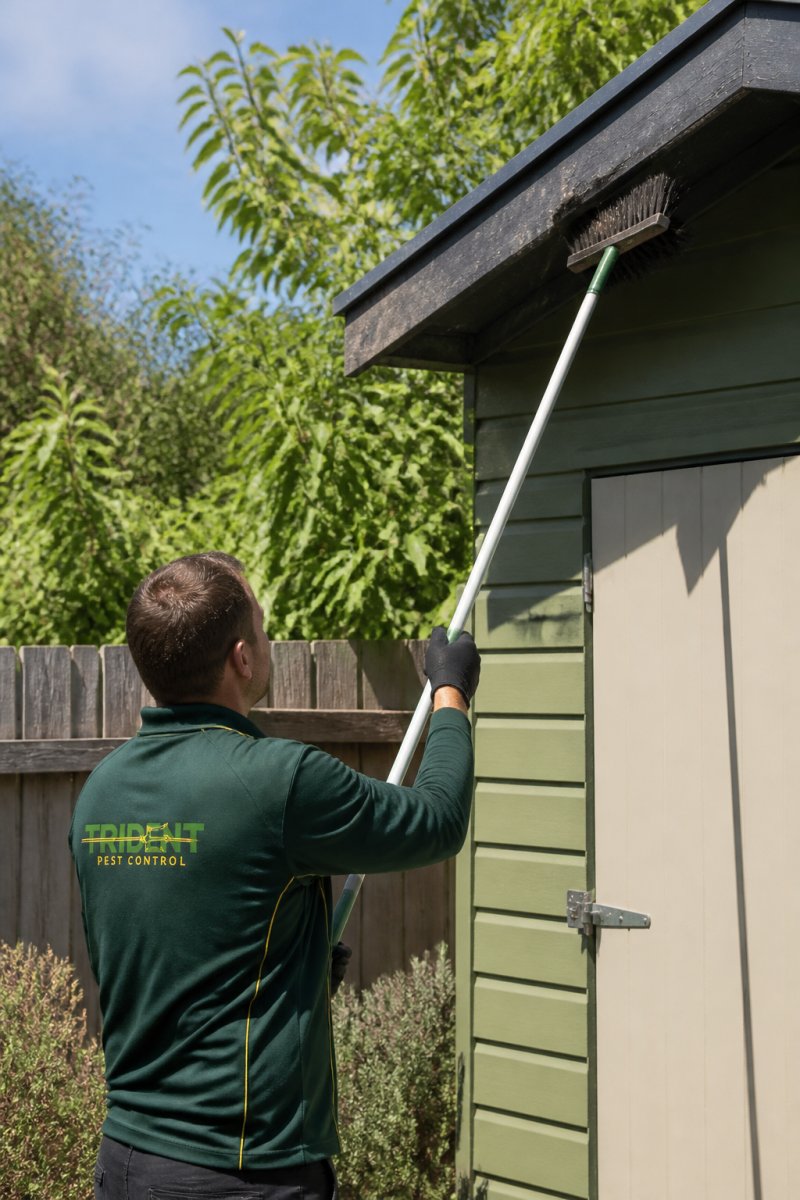
Removing webs and egg sacs early is the single most important step, and it’s the one most people skip.
Vacuuming or sweeping is an effective mechanical method for clearing spiders, webs, and egg sacs, according to the University of Kentucky Entomology Department. The same source notes that destroying egg sacs matters most, because a single sac can hold hundreds of young spiders.
So don’t just knock the web down. Check the corners, the eaves, and the back of the shed for small silk balls. Those are the next generation.
Use a vacuum with a hose attachment for indoor edges and a stiff broom outside. Empty the vacuum bag straight into an outdoor bin.
Knocking down a web without removing the egg sac is the most common mistake. The sac survives, and you’ll have a fresh spider population within weeks.
Trim Vegetation and Reduce Clutter
Trimming vegetation and cutting clutter removes the shelter spiders rely on during the day.
Industry best practice is to keep plants trimmed back at least a metre from structures and to reduce outdoor clutter that gives spiders somewhere to hide, according to Kingstowne Lawn & Landscape’s pest management guidance.
In practice, that means:
- Prune shrubs so they don’t touch brickwork or weatherboard
- Move firewood off the ground and away from the house
- Store pots upside down
- Clear leaf litter from corners and under decks
Spiders love a quiet, dark, undisturbed gap. Take those gaps away and they move on.
Natural Spider Repellent for Garden Use: What Works and What Does Not
Natural spider repellent for garden use works best as a deterrent, not a cure. Nothing natural will wipe out a spider population, but several options make an area less appealing.
What tends to help:
- Peppermint and eucalyptus oil sprays along skirting boards and window frames
- Vinegar and water wiped over surfaces spiders frequent
- Citrus peel placed in corners (replace it weekly)
- Cedar or eucalyptus mulch around garden beds
- Diatomaceous earth in dry cracks and gaps
What doesn’t work well:
- Ultrasonic plug-in devices (spiders don’t respond the way the packaging claims)
- Conkers or horse chestnuts (a persistent myth with no solid backing)
- Leaving essential oils out in the open (they evaporate within days)
The honest take: natural repellents are a supporting act. Mechanical removal and habitat changes do the heavy lifting. If you’re relying on a spray alone, you’ll be disappointed.
Reapply oil-based sprays every 7 to 10 days, and always after rain. Most people spray once, smell the peppermint, and assume the job’s done. It isn’t.
How to Get Rid of Spider Webs on Fences
Getting rid of spider webs on fences takes a broom, a hose, and a bit of patience. Fences are prime real estate for spiders because they offer long, undisturbed runs of timber.
Work in this order:
- Sweep the full length with a stiff broom, top rail to ground
- Check post caps and rail joins for egg sacs
- Hose down with a pressure spray on a low setting
- Wipe timber rails with a vinegar solution
- Trim any plants leaning against the fence
Timber fences are the worst offenders. The gaps between palings give spiders a ready-made hideout. If your fence is old and full of splits, sealing those gaps makes a real difference.
Do this every few weeks through spring and summer, when spider activity peaks. Once a season won’t cut it.
When to Call Professional Spider Control in Truganina
Professional spider control in Truganina is worth calling when webs keep returning despite regular cleaning, or when you’re finding spiders indoors rather than just in the garden.
Signs it’s time to bring someone in:
- Webs reappear within days of clearing
- You’re seeing spiders inside the house regularly
- You’ve found egg sacs in roof spaces or wall cavities
- Someone in the home has a reaction to bites
- You’ve got a young family or pets and want a safe approach
At Trident Pest Control, we handle spider treatments across Werribee, Truganina, and the wider western suburbs. Our technicians are licensed and insured, and we use kids and pet-safe methods. Pricing is fixed and quoted upfront, so there’s no surprise on the invoice.
For anyone searching for spider control near me in Melbourne’s west, same-day service is often available.
Common Mistakes That Let Spiders Come Back
Spiders come back because most people treat the symptom and leave the cause untouched.
The recurring mistakes:
- Clearing webs but not egg sacs. The population resets within weeks.
- Spraying everything. Chemicals kill what’s there but don’t stop new spiders moving in.
- Ignoring outdoor lighting. Lights feed the insect supply that spiders depend on.
- Leaving plants against the house. Instant shelter, right where you don’t want it.
- One-and-done treatment. Spiders rebuild. Prevention is ongoing.
- Skipping the roof void. Many indoor spiders come from above, not the garden.
| Mistake | Fix | Why It Matters |
|---|---|---|
| Webs only | Remove egg sacs too | Stops the next generation |
| Spray-only approach | Add mechanical removal | Chemicals don’t prevent re-entry |
| Bright outdoor lights | Switch to yellow or motion | Cuts the insect food supply |
| Plants touching walls | Trim back a metre | Removes daytime shelter |
| One-off clean | Repeat every 2-4 weeks | Spiders rebuild fast |
| Ignoring the roof | Check eaves and voids | Common indoor entry point |
Prevention beats reaction every time. Clear webs and egg sacs, cut the shelter, and manage the food supply. Do those three things and you’ll see far fewer webs.
Frequently Asked Questions
What is the best natural repellent for spiders in Australian gardens?
There is no single proven natural repellent that eliminates spiders entirely. The most effective approach combines mechanical removal with habitat modification. Vacuuming or sweeping removes webs and egg sacs, which is critical because egg sacs can contain hundreds of young spiders. Trimming vegetation back at least one metre from structures and reducing outdoor clutter also limits harbourage. Some gardeners use peppermint oil or citrus sprays as a deterrent, but results vary and these are best treated as a supplement to physical removal, not a replacement.
Do peppermint oil sprays actually stop spiders from building webs?
Peppermint oil sprays may discourage spiders from settling in a treated area, but they do not kill spiders or destroy existing egg sacs. The effect fades quickly, especially outdoors where rain and sun break down the oil. If you want to try peppermint oil as a natural spider repellent for garden use, apply it to entry points and sheltered corners, and reapply regularly. Pair it with sweeping and vegetation control for a more reliable result.
How often should I clear spider webs in my garden to discourage them?
Check and clear webs every one to two weeks during warmer months, when spider activity peaks. Focus on fences, eaves, window frames, outdoor furniture, and shed corners. Removing webs disrupts the spider’s food source and breeding cycle. If you find egg sacs, destroy them immediately. Consistent clearing is more effective than occasional deep cleans because spiders rebuild quickly in undisturbed spots.
How can I make my garden less attractive to spiders?
Reduce the features spiders rely on: trim shrubs and tree branches so they sit at least one metre from your house, clear leaf litter and stored items from against fences, and fix outdoor lighting that attracts insects. Spiders follow their food supply, so controlling moths, flies, and other insects around your garden also reduces spider numbers. Seal gaps around doors, windows, and weep holes to limit indoor entry. These steps take a few hours but cut harbourage significantly.
Spiders in the garden are a fact of life in Melbourne’s west, and total eradication isn’t the goal. Control is. If webs keep coming back no matter how often you sweep, it’s usually a sign the problem is bigger than the garden bed. Trident Pest Control offers licensed, insured spider treatments across Werribee, Truganina, and Geelong, with fixed pricing, no hidden charges, and kids and pet-safe methods. Get your free quote and take back your outdoor space.